Table of Contents
They dress the same window, solve the same problems, and cost surprisingly different amounts. Roman blinds versus roller blinds is the comparison almost everyone makes when curtains feel too much and bare glass feels too exposed, and it is usually made badly, from two showroom photos instead of from how each blind actually behaves across a year of mornings, dust, sunlight and small hands. This guide compares them honestly: how they look, how they control light, what they cost to buy and to clean, and which rooms each one genuinely suits.
Both styles belong to the family of internal window blinds, coverings fitted to the window itself rather than hung like curtains. Within that family they sit at opposite ends of the character scale: the roman is soft, folded and decorative; the roller is flat, plain and architectural. Neither is “better”. Each is right somewhere and wrong somewhere else.
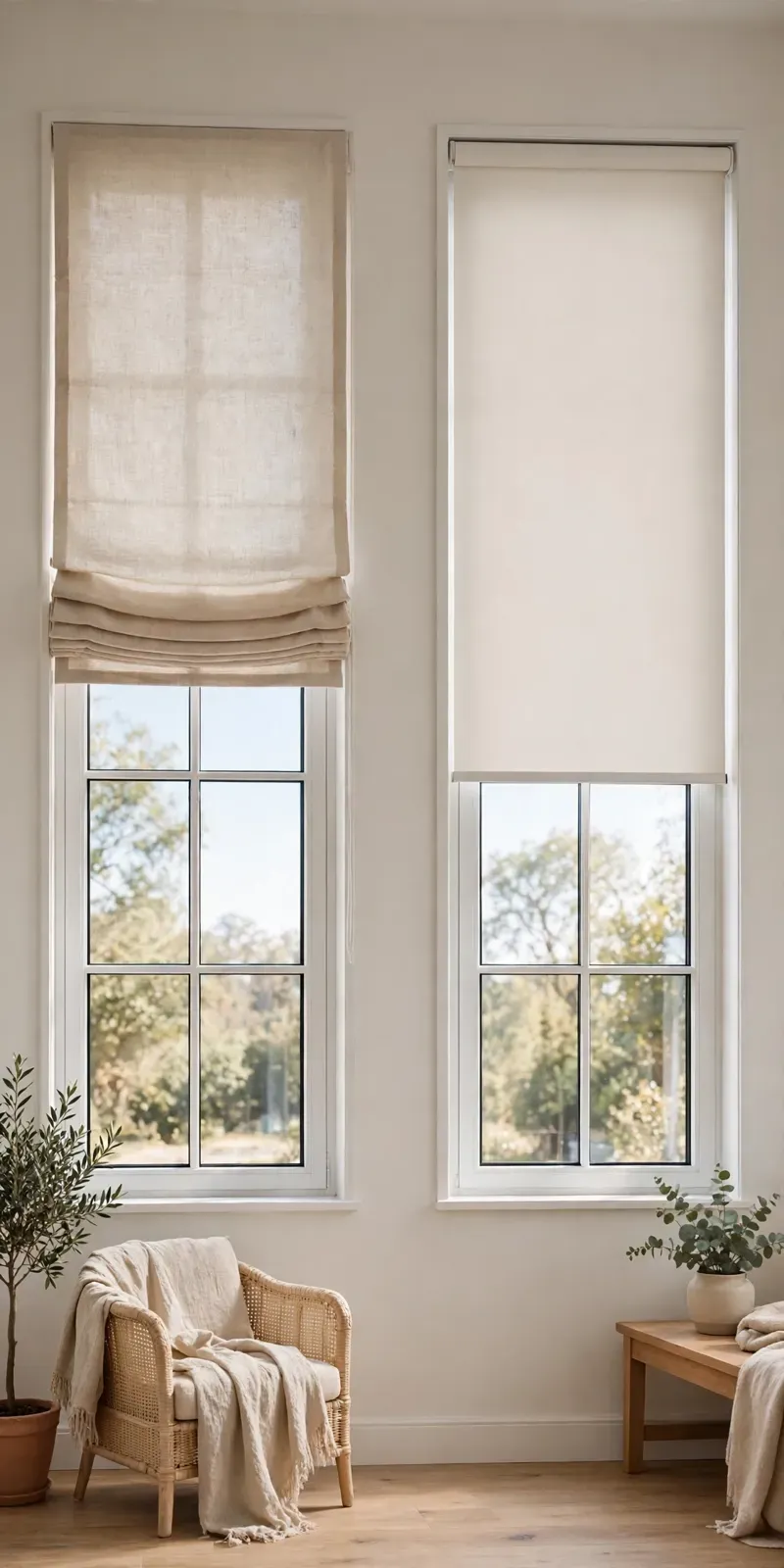
Roman Blinds Versus Roller Blinds: How They Look and Work
A roman shade, as the style is also called, is a flat panel of fabric that rises by folding itself into soft horizontal pleats. Half raised, it frames the top of the window with a tailored stack of folds; fully down, it reads like a fabric picture, which is why patterned and textured fabrics show at their best on a roman. The mechanism is cords or a chain working through rings and battens sewn into the back of the panel, so the fabric itself is the moving part and takes the wear.
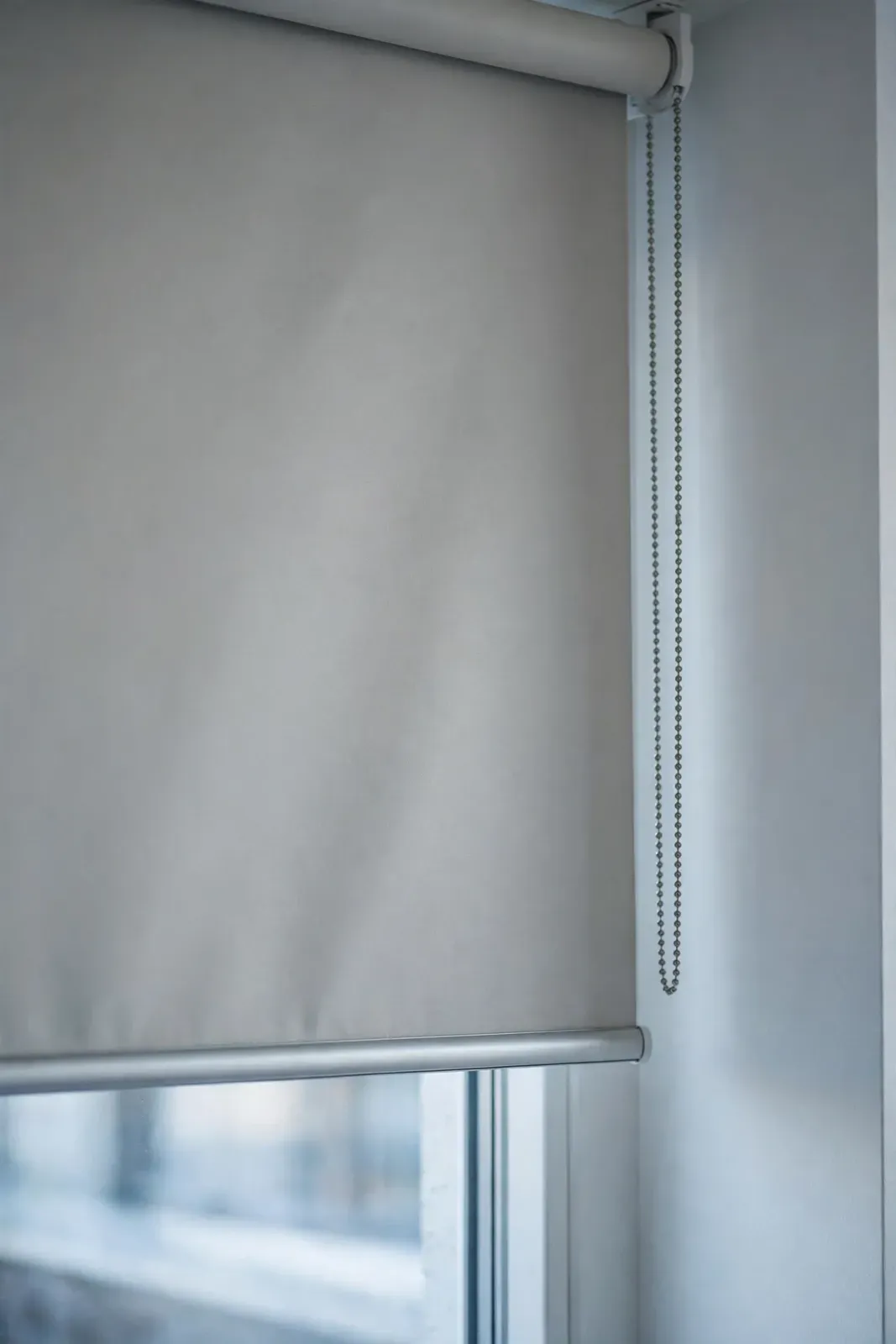
A roller blind is a single sheet of fabric wound on a tube. Raised, it nearly disappears, leaving the window completely clear; lowered, it is one flat, unbroken surface. The fabric is usually a purpose-made blind cloth, coated for stiffness, available in sheer, dim-out and blackout grades. There are no folds, no texture and no decoration beyond colour, which is precisely the point in rooms where the architecture, the view or other furnishings are doing the talking.

Roman Blinds Versus Roller Blinds: Light, Privacy and Insulation Compared
For light control, the roller wins on range: one window can take a sheer roller that works like a net curtain, or a blackout roller that seals a bedroom properly, and dual rollers even fit both on one bracket. Romans control light by fabric choice too, and a lined, interlined roman is an excellent blackout, but the cord holes and the gaps at the folds leak thin lines of light at dawn, which light sleepers notice. For insulation, the roman wins: its fabric, lining and trapped air in the folds form a genuinely warm layer, while a single sheet of roller cloth adds little beyond stopping draughts at the glass.
Privacy follows the same pattern for roman blinds versus roller blinds. A lowered roman in a lined fabric is fully private day and night. A roller is private in dim-out and blackout grades, but a sheer roller that protects you at noon turns transparent from outside once your lights are on, so street-facing rooms need the dim-out grade or a second covering after dark.
Roman Blinds Versus Roller Blinds: Costs, Cleaning and Lifespan
Roller blinds are the cheaper buy at almost every size, because the product is simple: tube, cloth, chain. Ready-made rollers for standard windows are inexpensive and can be trimmed to width at home. Romans cost more, ready-made and considerably more made-to-measure, because you are buying sewing as much as hardware. Over a ten-year life the gap narrows slightly: roman fabrics can be dry cleaned and relined, while a tired roller usually means a whole new blind, but rollers ask almost nothing along the way.
Cleaning is where the roller earns lifelong loyalty. Its flat cloth wipes down, tolerates bathroom steam and kitchen splashes in the right grades, and collects dust only on a surface you can reach. A roman blind gathers dust inside its folds, needs vacuuming with a brush attachment and occasional professional cleaning, and should never hang where cooking grease or heavy moisture floats. In a kitchen or bathroom, this single paragraph usually settles the roman blinds versus roller blinds debate.
Room by Room: Which Blind Where
Living room: roman, if the window is a feature and the room is dressed; roller, if the room is minimal or the window is huge, because wide romans get heavy and expensive.
Bedroom: roman with blackout lining for softness and warmth, or a blackout roller for the tightest seal, ideally inside the recess with curtains over.
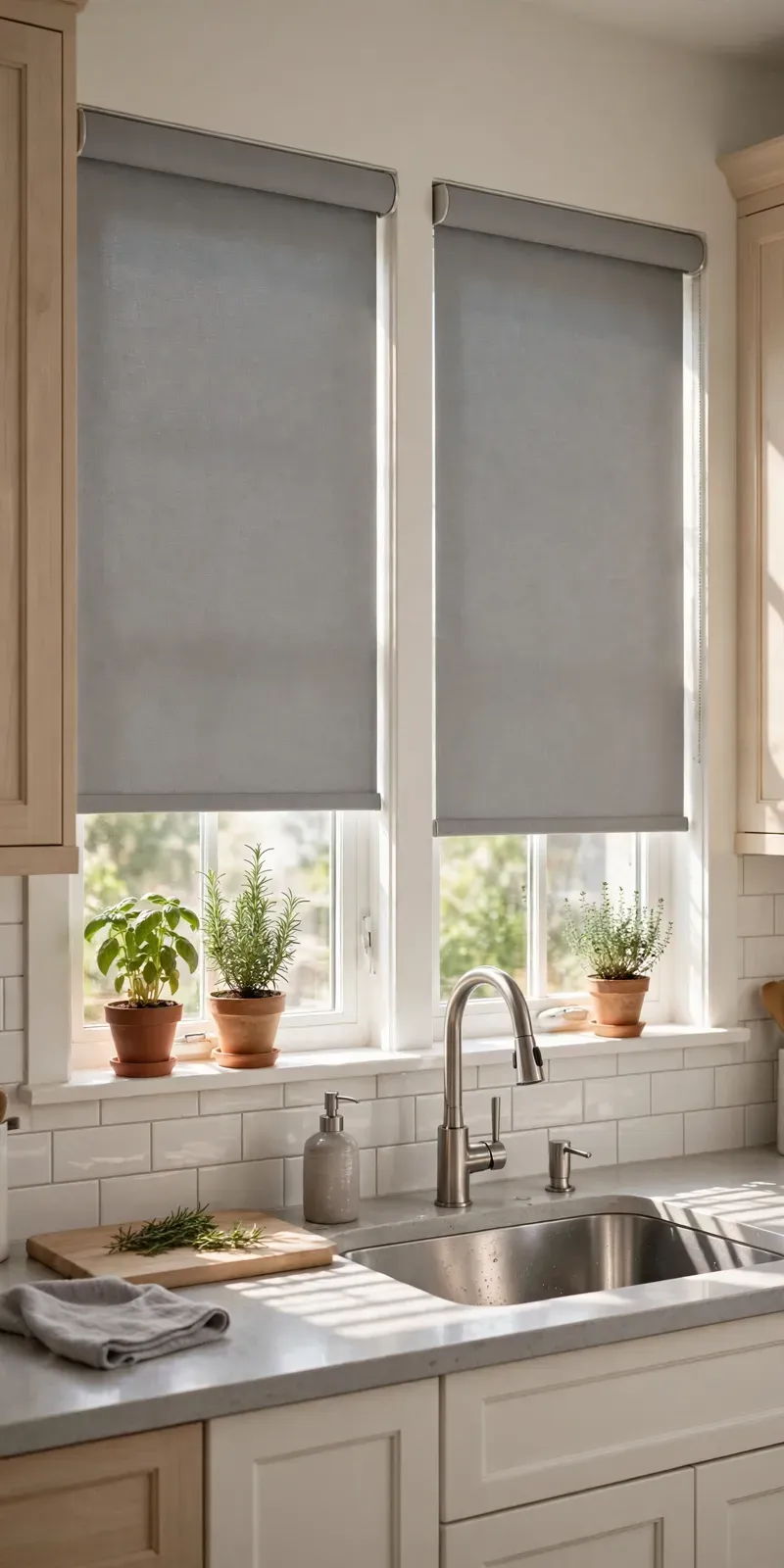
Kitchen: roller, without argument, in a wipeable fabric.
Bathroom: roller in a moisture-resistant grade, mounted with privacy in mind.
Home office: a sheer or screen roller, which cuts glare on a monitor while keeping the room bright; a roman leaves the screen user squinting against contrast.
Children’s rooms: either style, but cordless or motorised, or with cords cleated high and looped short, because blind cords are a recognised safety hazard for small children.
If a room in your home mixes sitting and sleeping, like a studio or a guest room that hosts grandchildren, consider the roman blinds versus roller blinds combination many fitters quietly recommend: a plain blackout roller inside the recess doing the practical work, and a roman in a fabric you love mounted outside the recess doing the looking beautiful. It costs less than a fully lined made-to-measure roman and outperforms both single options. Our accent chair styling ideas guide pairs well with this, since the roman’s fabric is a natural place to echo an accent colour across the room.
Buying Advice and Mistakes to Avoid
Measure inside the recess and outside it before choosing between roman blinds versus roller blinds, because the two blinds mount differently by habit: rollers usually sit inside the recess for a clean line, romans often sit outside it to cover the frame and block more light. Order fabric samples for romans and hold them at the window at night as well as noon; colours shift under lamplight. For rollers, check the roll direction: fabric rolling over the front of the tube sits away from the glass and clears handles, fabric rolling behind sits closer and blacks out better.
The common mistakes are predictable. Choosing a roman for a steamy bathroom. Choosing a decorative sheer roller for a street-facing bedroom. Forgetting window handles, so the lowered blind rests against them and bows. And ignoring the stack: a half-open roman still covers the top quarter of the glass, so on a short window that stack may block more view than you pictured. None of these are failures of the blinds; they are failures of matching the blind to the room, which is the whole roman blinds versus roller blinds game.
Frequently Asked Questions
Which is better for blackout in a bedroom?
For roman blinds versus roller blinds in a bedroom, a blackout roller fitted inside the recess gives the tightest seal against the glass. A blackout-lined roman blocks nearly as much light but leaks thin lines at its cord holes and folds. Light-sensitive sleepers should choose the roller, or layer either blind behind curtains for a belt-and-braces result.
Can roman blinds be motorised like rollers?
Yes, motorised roman blinds versus roller blinds are both available, and rollers are cheaper to motorise because the mechanism is simpler. Motorisation is worth considering for very wide windows, high windows, and any room where cords are a safety worry, since it removes the cord question entirely.
Which blind suits a rented home?
In a rented home, the roman blinds versus roller blinds winner is the roller, usually. It is cheaper, lighter, and often fits with minimal fixings, sometimes even with adhesive or clamp brackets that leave no holes. A made-to-measure roman is an investment you cannot take with you unless the next home has a window of the same size.
Do roman blinds work on very wide windows?
Up to a point for roman blinds versus roller blinds on very wide windows. Beyond roughly two metres, the fabric’s weight makes the blind heavy to raise and the folds uneven, and made-to-measure costs climb steeply. For wide windows, two separate romans side by side, or a roller, will behave better and look more deliberate.
How long do each type last?
How long each lasts is a fair roman blinds versus roller blinds question. A decent roller blind lasts seven to ten years before its cloth or mechanism tires; its chain and brackets are cheap to replace. A well-made roman lasts ten to fifteen years with a reline midway, because its value sits in the sewing. Treat both gently, and neither should be a frequent purchase.

Choose the roller for water, work and minimal lines; choose the roman for softness, pattern and warmth. Match the blind to the room’s real life, and the roman blinds versus roller blinds question answers itself.