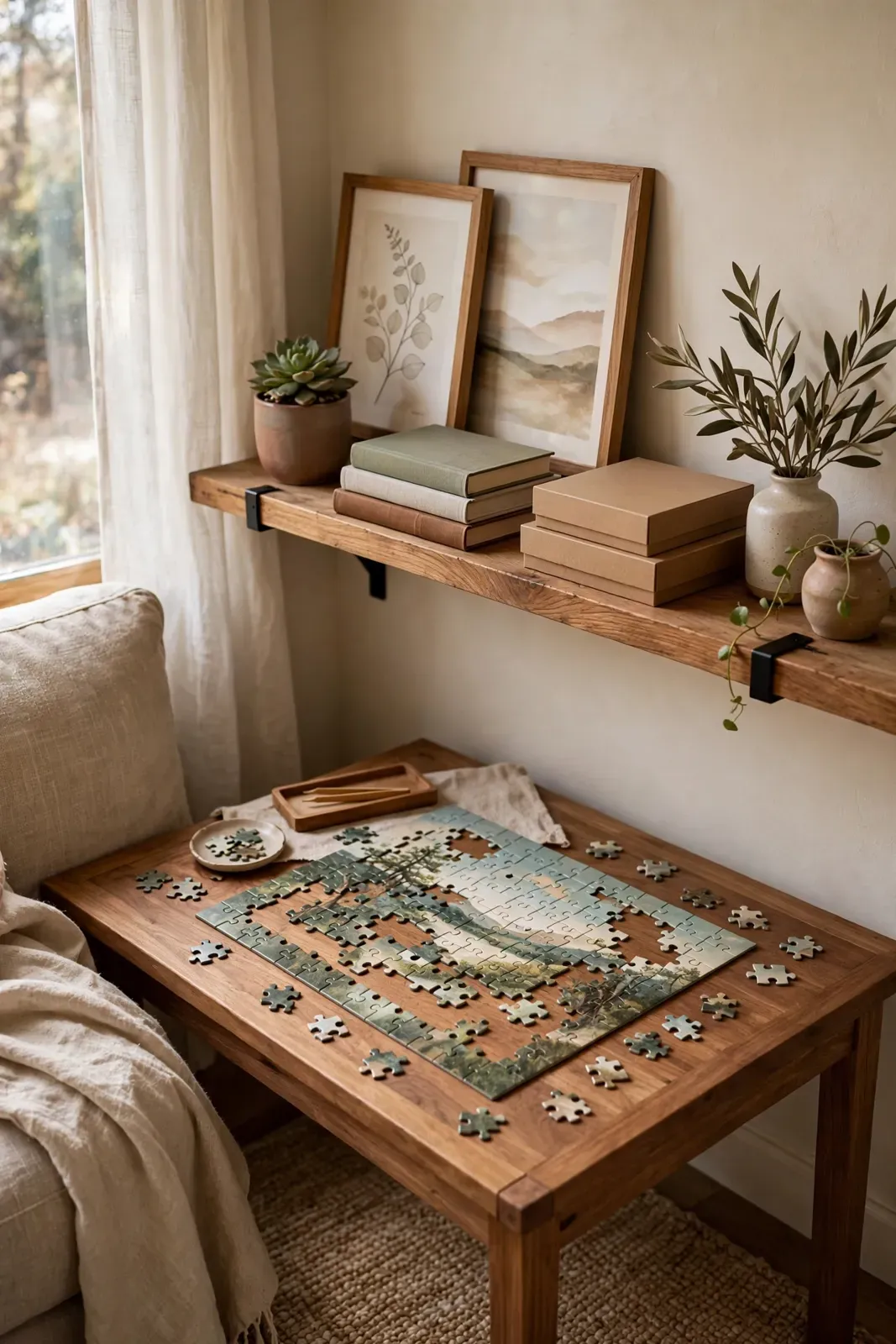
Most jigsaws start with good intentions and end in an argument about the dining table. Someone needs the space for dinner, homework or a laptop, so the half-finished picture gets balanced on a board, slid under the sofa, and quietly forgotten. A dedicated puzzle table living corner solves that problem in the simplest way: the puzzle gets its own small, permanent home, and it can stay out happily for days or weeks without getting in anyone’s way.
It does not need a spare room or an expensive piece of furniture. A quiet corner near a window, the end of a sofa, or that awkward stretch of wall no one uses well is usually enough. Once the corner is set up properly, puzzling stops feeling like a project you have to tidy away and becomes something you drift back to — ten minutes with morning tea, half an hour after dinner, a piece or two whenever you pass. That is the quiet promise of a good puzzle table living corner: it is always ready when you are.
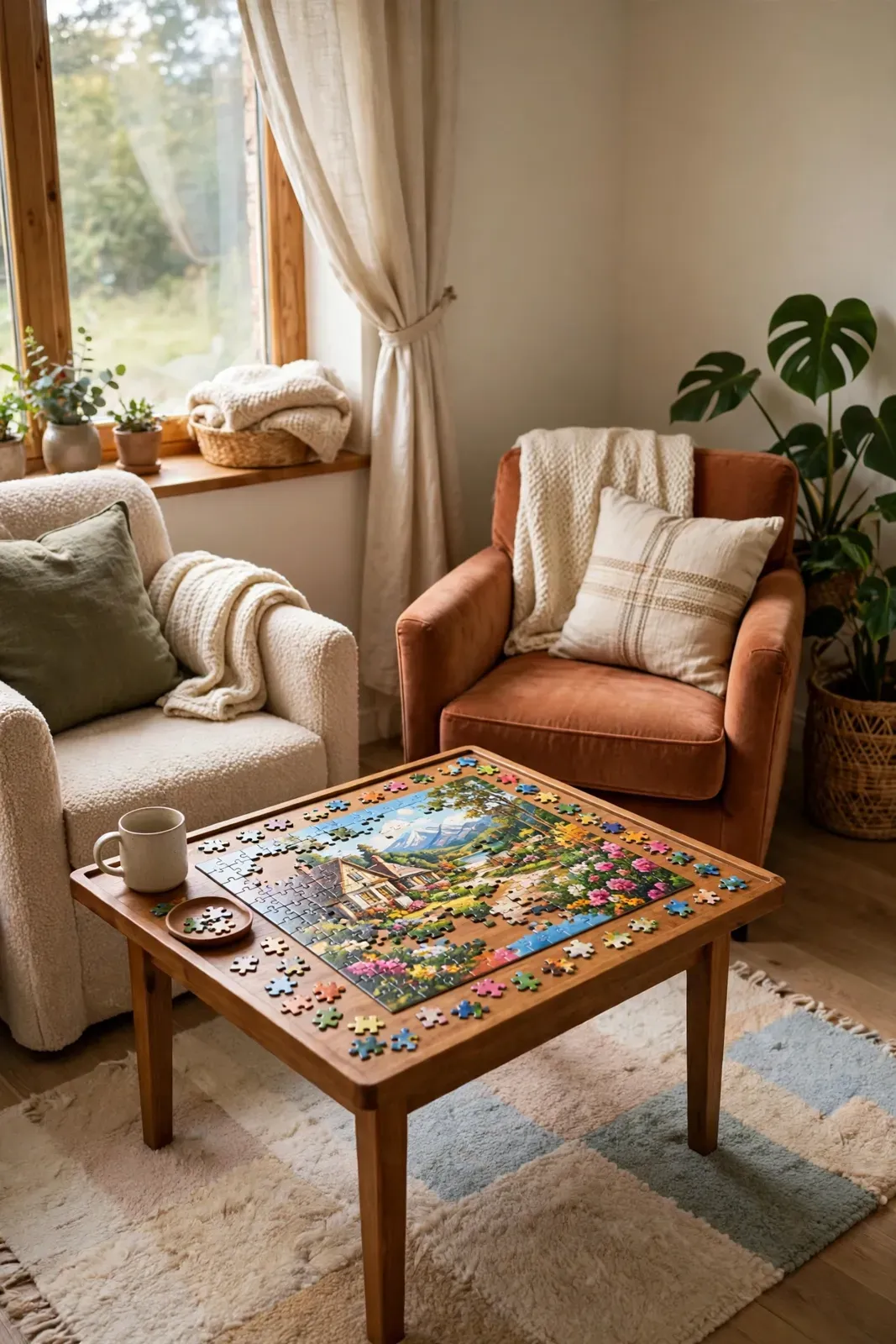
Why a Puzzle Table Living Corner Works So Well
A puzzle left out in the open behaves very differently from one packed away each night. You notice a piece that fits while you are doing something else. Guests pick up a few pieces without being asked. Children and grandparents can join in for five minutes without a big setup. That low, easy access is the whole point, and it is why so many families finish far more puzzles once the corner exists. Put simply, a puzzle table living corner turns puzzling from an occasional project into an everyday pleasure.
There is a long tradition behind this, too. The history of the jigsaw puzzle goes back to the 1760s, when early puzzles were cut from wood and used to teach geography. They have been a slow, sociable home pastime ever since, and they still suit real homes better than most screen-based hobbies because nothing needs charging, updating or putting on charge overnight. A puzzle table living corner simply gives that long tradition a permanent home.
A corner also protects the puzzle itself. Pieces stop travelling around the house in pockets and vacuum cleaners. The picture stays flat, the sorted groups stay sorted, and you stop losing the edge pieces that always seem to vanish when a puzzle is moved from table to table.
Choosing the Right Table for Your Corner
Size comes first. Measure your usual puzzle before you measure the corner. A standard 1,000-piece puzzle is roughly 68 by 47 centimetres, and you want the tabletop to hold that with room around the edges for sorted pieces and a cup. A top around 90 by 60 centimetres feels comfortable; smaller works if you mostly do 500-piece puzzles, and larger folding tables suit 1,500 or 2,000 pieces. When you plan a puzzle table living corner, measure the whole footprint, chair included, before you buy anything.
Height matters more than people expect. You will lean over this table a lot, sometimes standing, sometimes sitting. A normal coffee table height works well with low lounge chairs, while a slightly higher side table or small dining-height table is kinder on your back if you like to stand and puzzle. If your back aches after twenty minutes, the table is wrong, however pretty it looks. The right height makes a puzzle table living corner comfortable for years.
Look for a raised edge or lip if you can find one. It stops pieces sliding off when someone brushes past, and it keeps cats from treating loose pieces as toys quite so easily. A smooth, matte surface in a plain colour is best — very dark, very shiny or heavily patterned tops make it hard to see piece colours. Wood, simple laminate and felt-topped puzzle tables all work; glass looks lovely but shows every reflection under a lamp.
How to Set Up Your Puzzle Table Living Corner, Step by Step
You can put a good puzzle table living corner together in one afternoon. Work through it in this order:
- Step 1: Pick the quietest corner. Choose somewhere out of the main walking route, ideally with daylight from the side. Avoid spots right in front of doors, radiators or the television, where glare and draughts become daily annoyances.
- Step 2: Lay the base. Put a small rug under the table if the floor is hard. It softens the corner, marks it out as its own little zone, and saves dropped pieces from bouncing across the room. A rug also makes the puzzle table living corner feel deliberate rather than leftover.
- Step 3: Place the table and test the fit. Set the table down, lay out a finished-size board or tape the puzzle outline on top, and sit and stand at it for a minute each. Adjust the angle now, not after 400 pieces are down.
- Step 4: Add seating you will actually use. One comfortable chair is essential; a second small stool or pouf invites company. Cushions help on longer sessions.
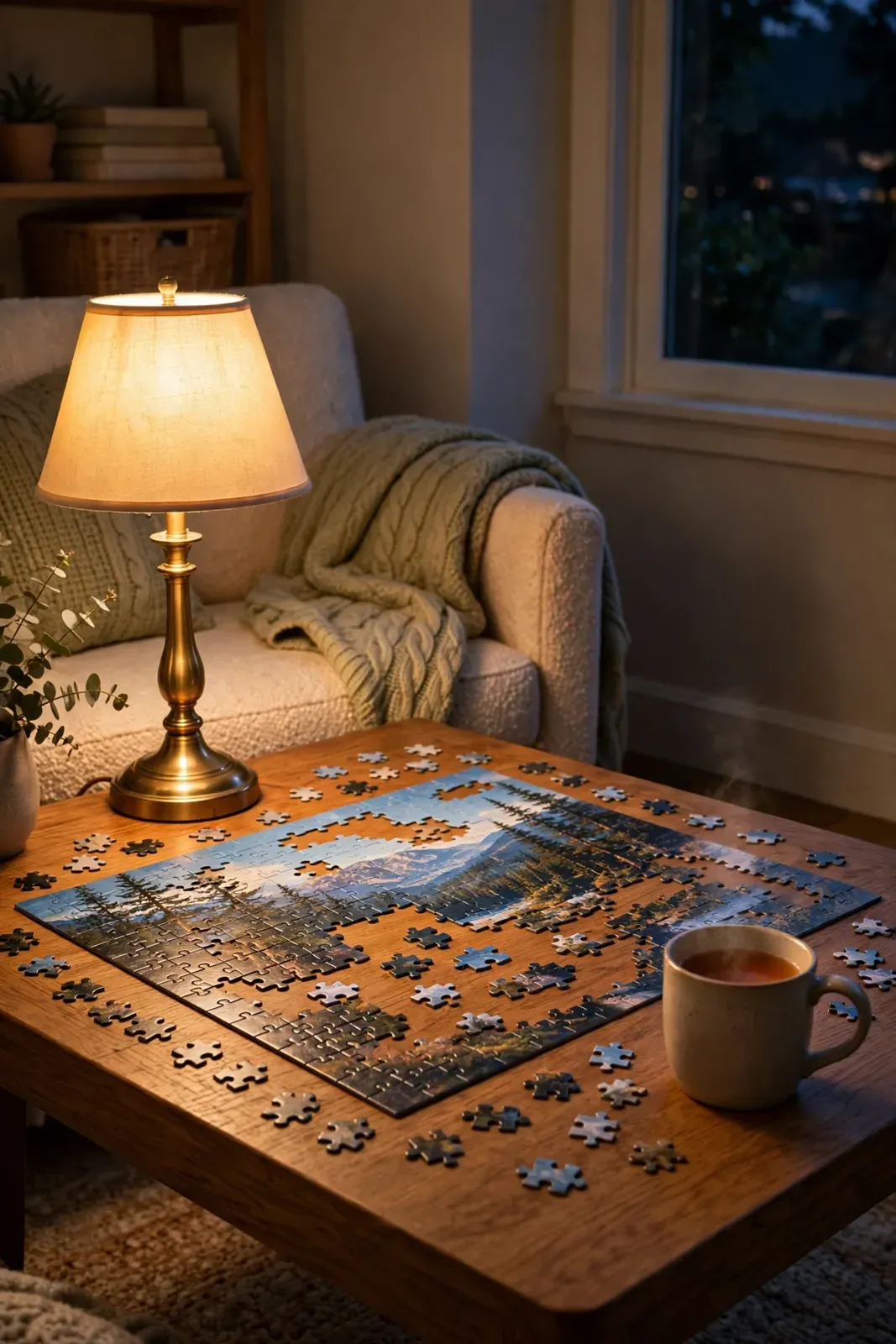
- Step 5: Sort the light. Add a lamp with a warm, bright bulb positioned to the side, not directly overhead. You should be able to tell navy from black pieces at night without straining.
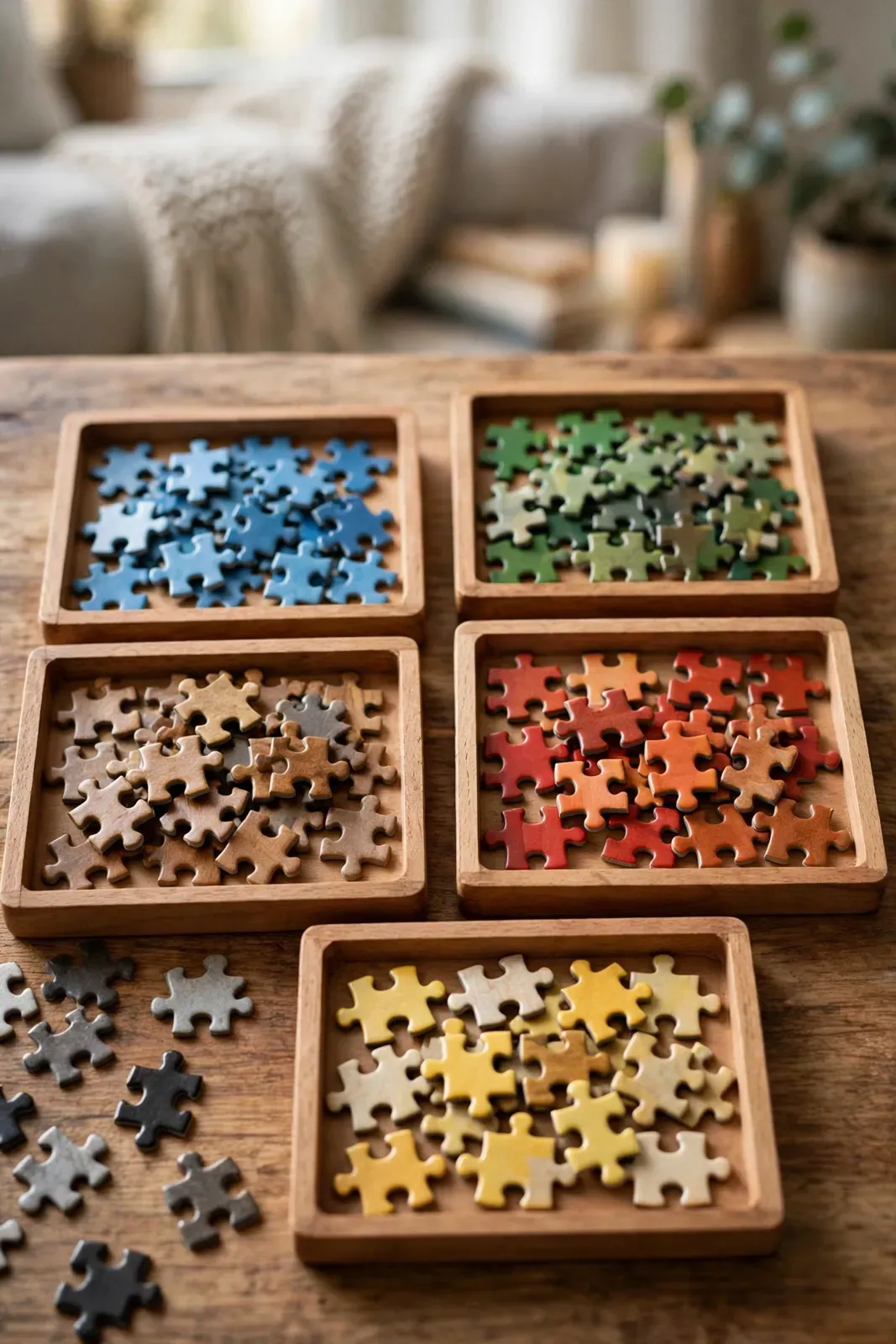
- Step 6: Set up sorting storage. Place three or four shallow trays, lids or small boxes on or under the table for edges, sky, faces and other colour groups.
- Step 7: Start the first puzzle and leave it out. That is the rule that makes the corner real. The puzzle lives there until it is finished, framed, photographed or boxed up by choice — never by pressure for the table. That is the moment a puzzle table living corner starts to work.
Sorting, Light and the Small Details That Keep It Tidy
A corner that stays out also has to stay presentable, because it is part of your living room. The trick is giving every loose thing a place. Sorting trays are the biggest help: shallow bamboo trays, baking trays with low sides, or the box lid itself all keep groups separate and stack neatly when you want the top clearer. A tidy puzzle table living corner invites you back far more often.
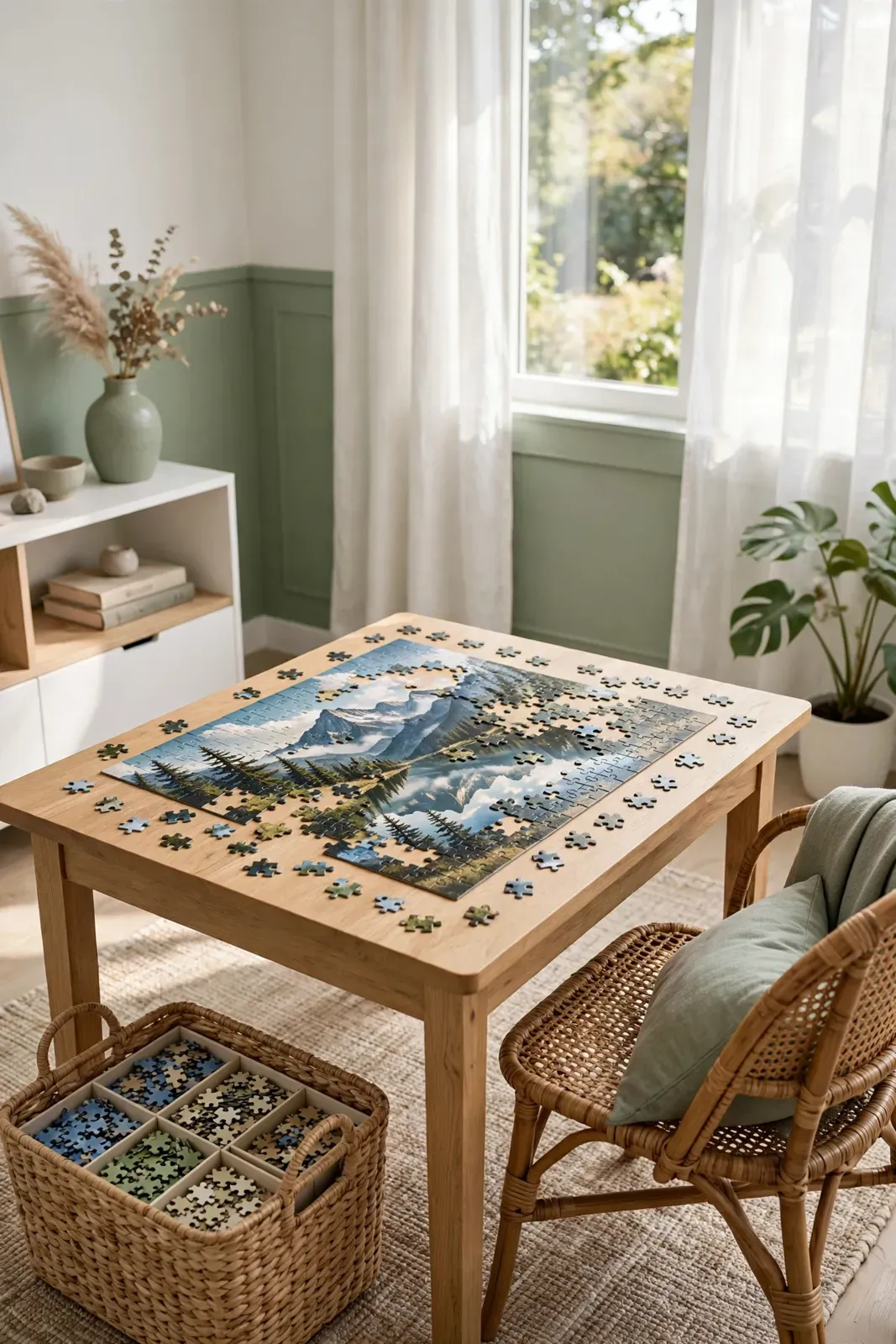
Keep one small basket nearby for the box, a magnifier if you use one, and a soft brush for dust. If your home has toddlers or curious pets, a light cotton cloth or a large felt mat laid gently over the puzzle at night protects it without moving a single piece. Some puzzlers use a roll-up mat for holidays, but day to day, a cover is faster and kinder to the picture.
Think about colour, too. A corner that matches the rest of the room — a cushion that picks up the sofa colour, a plant on a nearby shelf, a framed print above — reads as a chosen feature rather than clutter. Visitors usually read it as charming, especially when the puzzle in progress is a good picture. The same idea shapes our corner reading nook setup guide, and the two corners sit happily side by side in one room.
Budget and Buying Advice: Spend on the Table, Save Everywhere Else
This is a forgiving project for a small budget. The table is the only real purchase, and it does not have to be sold as a puzzle table. A second-hand side table, a small folding card table, or an unused console table can all do the job for very little. Check charity shops and local listings first; solid older tables are often sturdier than cheap new ones. A second-hand table can anchor a puzzle table living corner for years.
If you buy new, expect simple folding puzzle tables to cost about the same as a family takeaway or two, while wooden tables with drawers and a tilting top cost more and suit daily puzzlers. Drawers are genuinely useful for sorting, and a tilting top helps with neck strain on big puzzles, but neither is essential. Spend first on the right size and a stable frame — a wobbly table will annoy you every single session. Spend wisely and the puzzle table living corner stays a cheap hobby.
Save money on accessories. Trays can be lids and shallow boxes you already own. Lighting can be a lamp moved from a bedroom. For puzzles themselves, swaps with friends, library sales and charity shops keep the shelf full for pennies, and a shared family puzzle makes a thoughtful, inexpensive gift. If you enjoy other kinds of puzzles and brain games as well, the same corner happily holds crosswords, a chess set or a sketchbook between jigsaws. Even empty, a puzzle table living corner looks like an invitation.
Common Mistakes to Avoid
- Choosing a table that is too small. If sorted pieces have nowhere to go, they end up in piles, get mixed, and the puzzle slows to a crawl.
- Putting the corner in a walkway. One knocked table can undo a week of work. If people squeeze past it daily, move it. A puzzle table living corner belongs out of the traffic.
- Relying on weak ceiling light. Poor light makes similar colours look identical and turns a relaxing hobby into eye strain. A side lamp fixes this cheaply.
- Starting a puzzle far beyond your patience. A 3,000-piece picture that stalls for two months will make the corner feel stuck. Match the size to the time you really have.
- Letting the corner collect unrelated clutter. Post, chargers and paperwork creep in fast. A weekly two-minute clear-out keeps it inviting.
- Moving the puzzle mid-way. Every move loses pieces. If you must move it, slide it onto a large board first and carry it flat, with help.
Frequently Asked Questions
How much space do I really need for a puzzle corner?
About one square metre is enough for a small table, one chair and a lamp. Measure your usual puzzle size first, add room for sorting trays, and check you can sit down and stand up without shuffling sideways. A true puzzle table living corner needs less room than most people fear.
What if I do not have a spare table?
Use a large puzzle board or a sheet of stiff card on top of an existing side table, or try a folding tray table. The corner matters more than the furniture — what counts is that the puzzle does not have to be packed away each day. Any flat surface can start a puzzle table living corner.
How do I keep dust and pets off an unfinished puzzle?
Lay a light cloth or felt mat over it at night, keep sorting trays covered or stacked, and sweep the corner weekly. Most cats lose interest once there is a cover; dogs usually only bother loose pieces on the floor, so check under the table when you tidy.
Which puzzle size is best to start with?
A 500 or 1,000-piece puzzle with a clear, varied picture is ideal. Lots of distinct colours and detail keep sorting satisfying, while huge areas of plain sky or sea are best saved until the habit is established. Start small and your puzzle table living corner will be used daily.
Can children share the corner?
Yes, and many families find it works best that way. Give younger children their own tray and a section of edge or a simple colour area to own. Agree one house rule early: nobody moves or hides anyone else’s pieces.
A puzzle table living corner is a small change that gives you a slower, kinder corner of the home in return. Set it up once, choose a picture you genuinely love, and let it wait for you — a few pieces at breakfast, a few more before bed. There is no deadline, no score and nothing to tidy away. Just a picture, appearing piece by piece, in a corner that is finally being used well.