Table of Contents
My carnelian orange stone necklace was a market find I nearly walked past. The stall was closing, the light was going, and the pendant looked like an ordinary orange bead until the stallholder held it up to the sun. The whole stone lit up from inside, amber at the edges and deep rust-red in the middle, and I bought it before she had finished telling me the price. Three years later it is the necklace I reach for on flat mornings, because warm orange against the skin does what a good lipstick does: it makes everything else look more awake.
This guide is my honest routine for a necklace like this: nine warm ways I wear mine through the week, layering steps that stop chains tangling, the colours that flatter the stone, and the checks that tell a real stone from a dyed imitation. Everything here is about wearing a carnelian orange stone necklace well on ordinary days.

9 Warm Ways to Wear a Carnelian Orange Stone Necklace
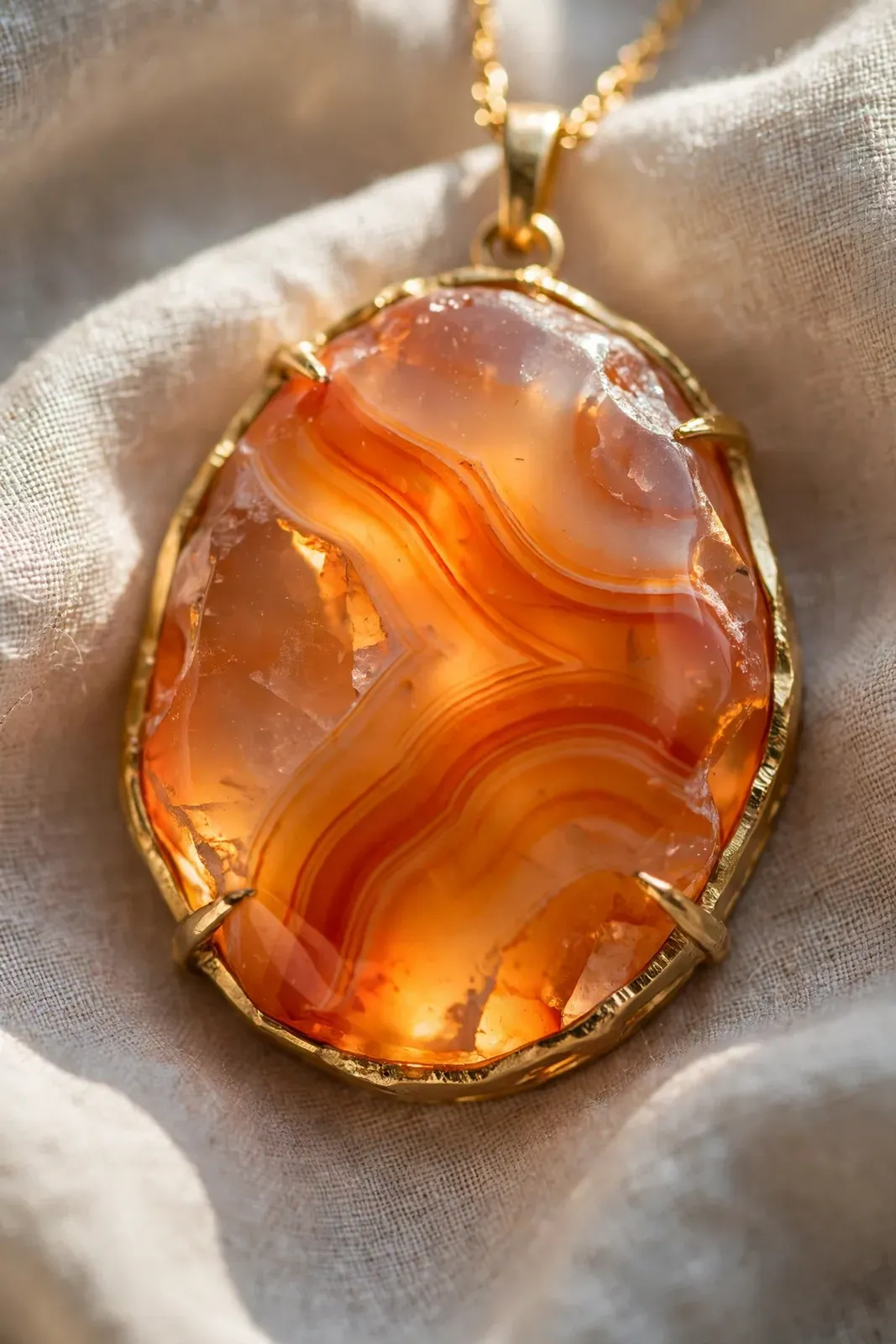
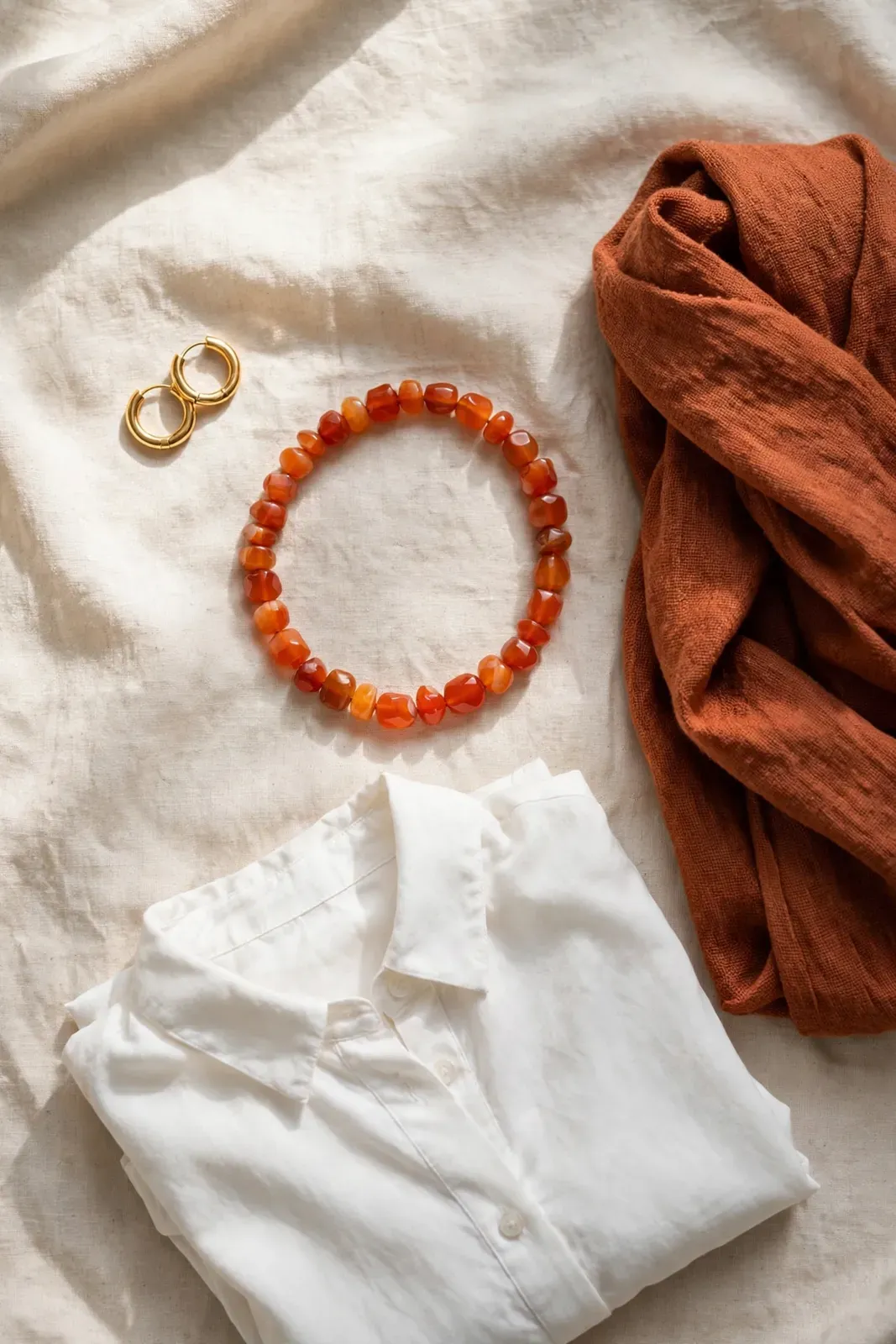
First, the hero look above: one teardrop pendant on a fine gold chain over a cream or ivory blouse, worn alone. Cream is the easiest background because the orange reads rich and clear against it, and the look works for work, lunch and anything that needs polish without effort. Second, the white shirt version from the flat-lay: pendant just below the open collar of a crisp white shirt, with small gold hoops. It is my five-minute pulled-together outfit. A carnelian orange stone necklace does the quiet work in both looks.
Third, the teal contrast in the fourth photo: a beaded carnelian strand against a deep teal or petrol-blue dress or top. Orange and teal sit opposite each other, so both colours look stronger, and this is my most-complimented evening pairing. Fourth, the denim look in the last photo: a smaller pendant over a white tee under an open denim jacket. The stone warms up the blue and stops the outfit feeling plain. Fifth, the knit version: a longer pendant over a fine camel or rust jumper, where the stone glows against the warm wool.
Sixth, the black dress version: one bold pendant on a longer chain over a plain black dress, where the orange does the work of a whole jewellery set. Seventh, the layered look: the pendant as the longest layer under two shorter gold chains, over a plain scoop-neck top. Eighth, the scarf swap: thread a small pendant onto a silk neck scarf, so the stone sits at the knot like a clasp. Ninth, the weekend beads: a full strand of round carnelian beads with jeans, a linen shirt and sandals, no other jewellery at all. Nine ways, one stone, and none of them needs a special occasion. That is the charm of a carnelian orange stone necklace: one piece, nine outfits.
How to Style and Layer Your Carnelian Orange Stone Necklace Step by Step
Step one: start with the neckline, not the necklace. As a starting point it helps to know that a necklace is an article of jewellery worn around the neck, and the oldest rule of wearing one is that the pendant should either sit clearly above the neckline on skin, or clearly below it on fabric, never stranded exactly on the edge where it flips and hides. V-necks and open collars suit a pendant that follows the V. Crew necks suit a longer chain that rests on the fabric. Scoop necks take almost anything.
Step two: pick your length honestly. A 40 to 45 centimetre chain puts the pendant at the collarbone, the most flattering spot for most faces. A 50 to 60 centimetre chain drops it onto the chest, better over knits and high necklines. If your necklace has an extender, use it: two centimetres changes where the pendant sits entirely. Measure first, and your carnelian orange stone necklace will sit exactly where it should.
Step three: layer in odd numbers with gaps. Shortest chain first, carnelian pendant last and longest, at least four centimetres between layers so they do not braid together by midday. Keep the metals in one family: warm gold with carnelian, because silver cools the orange down. Step four: check the weight balance. A stone pendant on a very fine chain pulls the clasp round to the front; a sturdier chain keeps it where it belongs. For more stacking combinations, see my guide to layered necklaces for women, with nine tangle-free ways to stack chains and pendants.
Step five: finish with a mirror test in daylight. Carnelian looks soft apricot indoors and almost red outside, so check it in the light you will actually be in. If the stone looks dull, it usually needs a wipe with a soft cloth rather than a different outfit. Small checks like this keep a carnelian orange stone necklace looking its best all day.
The Stone Itself, and the Colours It Loves
A little knowledge makes the wearing better. Carnelian is a brownish-red to orange variety of chalcedony, a quartz family stone that has been carved into beads and seals for thousands of years. Its colour comes from iron oxide, the rust tones you see in the close-up photo, where the banding and cloudy patches are natural character, not flaws. Good carnelian is translucent: hold it to the light and the edges glow while the centre stays deeper.
For colours, work in families. Warm neutrals first: cream, ivory, camel and tan let the stone lead. Then the strong contrasts: teal, petrol blue and denim blue sharpen it, and deep bottle green gives a rich, autumn feel. Olive and khaki suit the beaded strand quietly. The difficult neighbours are other hot brights: a scarlet top or hot-pink scarf fights the orange for the same attention. Pastel peach washes it out. When in doubt, hold the necklace against the fabric and step back: the right pairing makes the stone look lit, the wrong one muddy. Trust that test and your carnelian orange stone necklace will rarely clash.

Buying, Budget and Care: Real Stone Checks That Work
Before you buy, run the checks jewellers use. The light test: hold the stone against a phone torch. Real carnelian shows cloudy, uneven colour with soft banding; dyed agate and glass often show colour pooled in cracks or a flat, jam-like evenness. The touch test: real stone feels cool against the cheek and warms slowly, while plastic and resin feel warm and light straight away. The weight test: a stone pendant has a satisfying heft in the palm; if it feels like a toy, it probably is one. None of these tests is perfect alone, but together they catch most imitations.
On budget, spend on the stone and save on the chain: an expensive chain cannot rescue a dyed bead. Ask the seller plainly whether the stone is natural or dyed. Much market carnelian is heat-treated or dyed, which is accepted when disclosed; undisclosed dyeing is your reason to walk away. Vintage and handmade market pieces, like mine, are often the best value, with thicker stones than modern mass-made pendants. A well-chosen carnelian orange stone necklace should feel substantial, never flimsy.
Care is gentle and brief. Wipe the pendant with a soft, slightly damp cloth after wearing and dry it before putting it away. Keep it out of perfume and hairspray, which dull the polish, and store it in its own pouch so harder stones do not scratch it. Warm soapy water and a soft brush handle a deeper clean; skip ultrasonic cleaners for beaded strands, because the thread suffers even when the stone does not. Gentle care like this keeps a carnelian orange stone necklace glowing for years.

Common Mistakes to Avoid with an Orange Stone Necklace
The first mistake is wearing it against an equally loud colour and wondering why the outfit looks restless. Orange jewellery needs quieter clothes or one clear contrast, not a competition. The second is choosing a chain so fine that the clasp spends the day travelling to the front; match the chain to the pendant’s weight. The third is layering chains of nearly the same length, which guarantees a tangled knot by lunchtime. Keep clear gaps between layers, or wear the pendant alone.
The fourth mistake is judging colour under shop lighting only: fluorescent light flatters pale stones that look washed out at home, so check near a window before paying. The fifth is storing carnelian loose in a mixed box, where it picks up fine scratches. A soft pouch keeps the polish that makes the stone look alive. Treat a carnelian orange stone necklace gently and it rewards you daily.
Frequently Asked Questions
What colours go best with a carnelian orange stone necklace?
Cream, ivory, camel and white are the easiest partners, and teal, denim blue and bottle green give the strongest contrast. Warm gold jewellery suits the stone best. Avoid scarlet and hot pink at the same strength, and be careful with pale peach, which can wash the colour out.
How can I tell if my carnelian is real?
Hold it to the light: real carnelian is translucent with cloudy, uneven colour and soft banding, and it feels cool and weighty in the hand. Dyed imitations often show colour pooled in cracks or a suspiciously even, flat orange. When buying, ask directly whether the stone is natural, dyed or heat-treated.
Can I wear a carnelian necklace every day?
Yes. Carnelian is a hard, durable quartz stone that stands up well to daily wear, which is why it suits a daily necklace. Take it off for swimming, heavy workouts and spraying perfume, wipe it with a soft cloth now and then, and store it in a pouch to protect the polish. That is why a carnelian orange stone necklace suits daily wear so well.
What chain length suits a carnelian pendant?
A 40 to 45 centimetre chain rests at the collarbone and suits most necklines and faces. Choose 50 to 60 centimetres for wearing over knits and high necklines. An extender chain is worth having, because a small change in length can completely change where the pendant sits. The right length makes a carnelian orange stone necklace comfortable from morning to night.
Does carnelian suit every skin tone?
Its warm orange flatters warm and neutral skin tones most obviously, bringing out golden undertones. On cooler skin it still works as a deliberate contrast, especially in the deeper rust-red shades and worn against teal or navy, which balance the warmth of the stone. That balance is why a carnelian orange stone necklace flatters so many wearers.
One warm stone, nine ways, worn on ordinary days.
That is the real pleasure of a carnelian orange stone necklace: it asks for nothing special, just a neckline that gives it room and colours that let it glow. Hold yours up to the light, pick the pairing that makes it light up, and let it earn its place in your everyday rotation.