Anyone who has slept through a warm night in mosquito country knows the particular misery of hearing that one high whine circle the pillow at 3 a.m. A mosquito net canopy bed drape ends it — and, almost by accident, turns an ordinary bed into the prettiest thing in the room. The soft fall of netting around a bed looks like pure romance, but it is one of the oldest pieces of health equipment in the home. This guide covers how to choose the right net and shape, how to hang it so it drapes beautifully and works properly, and how to care for it through the season.

Table of Contents
Why a Mosquito Net Canopy Bed Drape Still Matters
Nets are not a quaint tradition; they are proven protection. The comparison of canopy, box and pop-up bed nets used by health programmes makes the simple point clearly: a fine mesh, intact and properly tucked, is a physical barrier that works every night without sprays, coils or electricity. Research summarised in the history of mosquito nets credits treated nets with averting hundreds of millions of malaria cases this century — the same drape that softens your bedroom light has a serious pedigree.
For most homes in Pakistan and similar climates, the everyday stakes are lower but real: unbroken sleep, children not scratched raw by morning, and evenings with the windows open to whatever breeze exists instead of sealed behind screens and chemicals. A net buys back the open window, which on a hot night is worth more than the net itself.
And then there is the look. A bed inside a fall of white netting reads as calm in a way no headboard can match. Hotels in tropical countries have used the trick for a century: the net is the decoration, and the room needs little else.
Choosing a Mosquito Net Canopy Bed Drape: Hoop, Box or Four-Poster
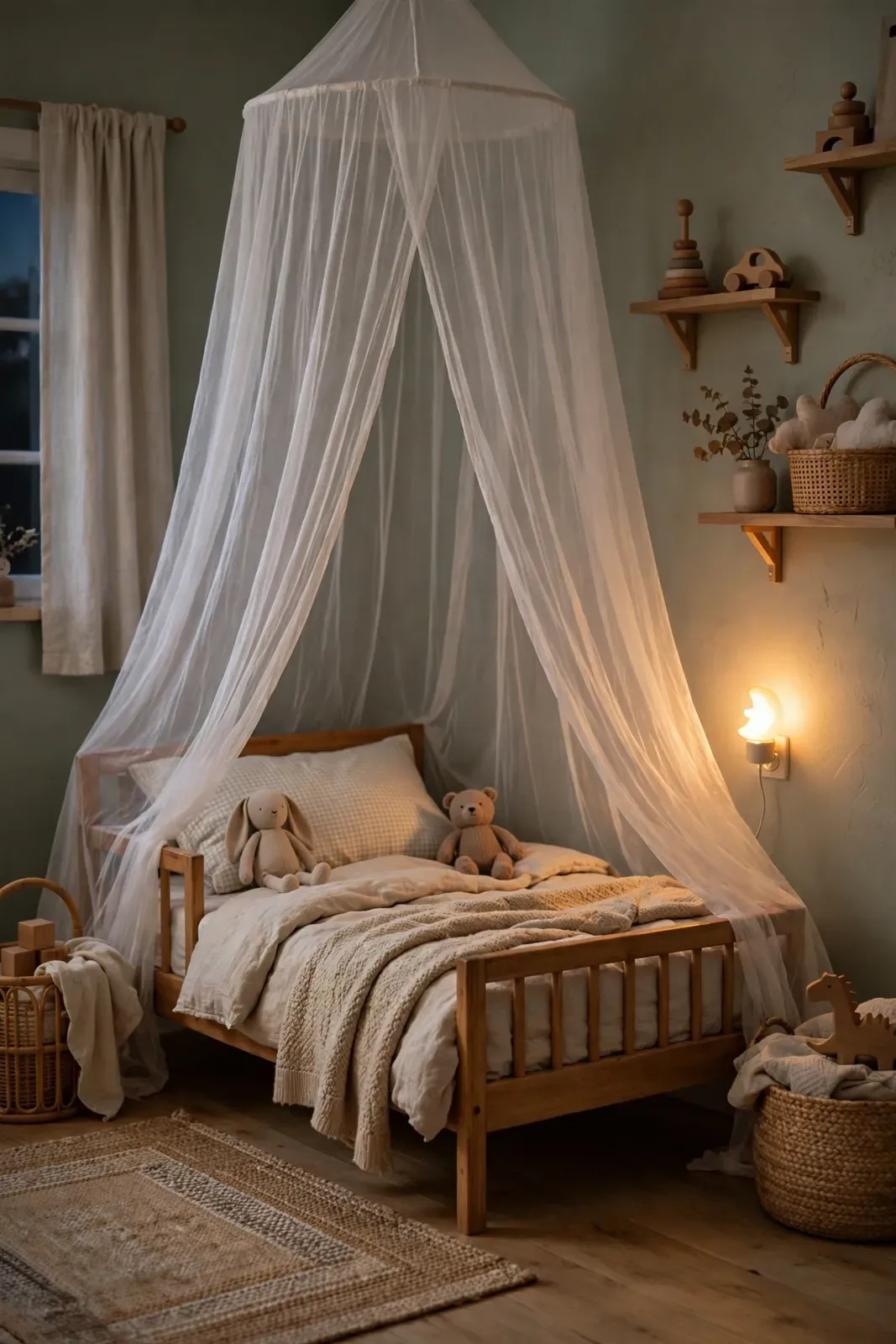
The round hoop canopy hangs from a single ceiling hook and falls in a cone. It is the easiest to install — one fixing, no frame — and the most romantic, but the cone narrows towards the top of the bed, so restless sleepers may touch the mesh. Choose a generous hoop diameter and the longest drop you can; a hoop net that pools slightly at the floor seals far better than one that ends at the mattress.
The box or rectangular net hangs from four points or a frame and gives vertical walls of mesh with full headroom. It is the practical champion for couples, for children who move in their sleep, and for anyone using a fan inside the net’s space — the mesh stays clear of faces and feet. It asks for four ceiling hooks or a four-poster frame, which is its only real cost.
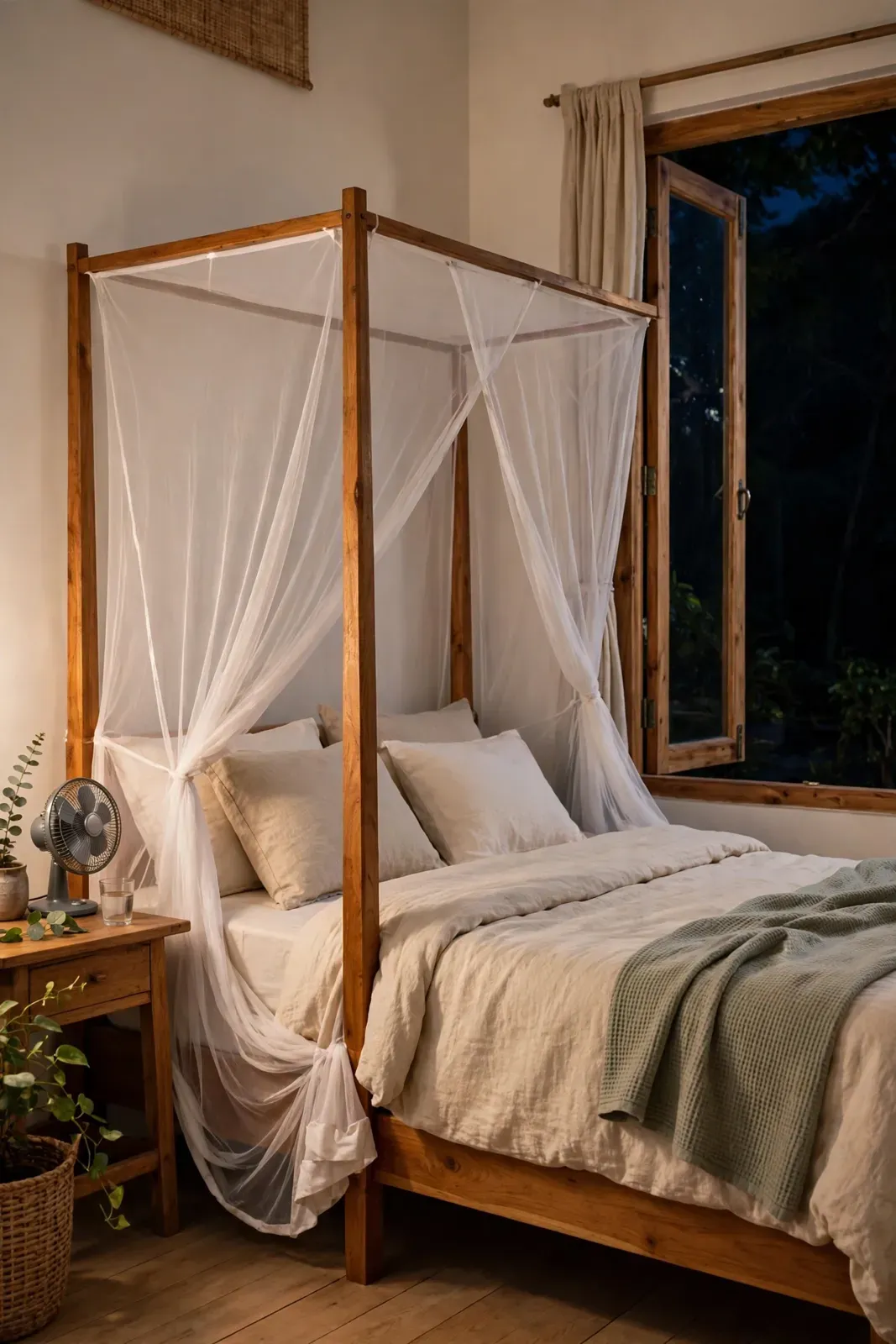
Four-poster drapes wrap netting over an existing frame. If your bed already has posts, this is the neatest solution of all: no ceiling fixings, panels that tie back by day, and a fall of fabric that looks tailored rather than tent-like. Whatever the shape, mesh size is the specification that matters: around 1.2 millimetres stops mosquitoes, and a finer mesh near 0.6 millimetres also stops the tiny biting midges that laugh through standard netting.

Hanging a Mosquito Net Canopy Bed Drape So It Looks Right
Proportion is everything. A canopy looks luxurious when the netting is fuller than the minimum — buy one size up from the bed’s bare requirement so the fabric falls in folds rather than hanging drum-tight. Tight netting reads as equipment; soft folds read as a drape. White and ivory soften a room; pale sage or blush tints suit coloured bedrooms but show dust sooner and are harder to replace with an exact match.
Height decides the mood. Hung high, with the fall starting well above the pillows, a net feels airy and grand. Hung low it feels cosy and enclosed, and some sleepers find it close. If in doubt, go high: you can always let more fabric down, and the extra drop buys you the floor-pool that seals the bottom edge.
By day, tie the panels back to the posts or gather the hoop net to one side with a ribbon or a plain band. A bed made inside an open fall of netting photographs beautifully and functions badly — making the bed through mesh teaches you to do the tie-back properly within a week.
Setting Up Your Mosquito Net Canopy Bed Drape Step by Step
Step 1 — Wash the net first. New netting often carries a dressing that smells chemical and hangs stiff. A gentle wash and line-dry before first hanging gives you the soft drape from the first night.
Step 2 — Fix the hanging points. Use a proper ceiling hook into a joist or a strong plug for a hoop; for box nets, mark four points slightly wider than the bed so the walls of mesh fall vertically, not inward.
Step 3 — Hang and adjust the fall. Let the net down all round, then walk the room: the mesh should clear the pillows, pool or tuck evenly, and leave no gap at the corners where the two sides meet.
Step 4 — Seal the bottom. Tuck the lower edge under the mattress, or weight the hem so it rests fully on the floor all round. An unsealed bottom turns the net into a mosquito trap with you inside it — the single most common setup failure.
Step 5 — Do the entry drill. Decide how you will get in: lift one section, slip in, and re-tuck. Practise it twice in daylight. At 2 a.m., half asleep, you will do whatever you practised.
Budget and Buying Advice for a Mosquito Net Canopy Bed Drape
Nets are inexpensive compared with what they replace, and the price differences mostly buy fabric quality and size. Very cheap nets use coarse, stiff mesh that tears at the hanging points within a season; a mid-priced net in a finer, softer mesh lasts years and drapes far better from the first night. Given that the drape is half the point, the softer fabric is worth the small premium.
Buy the fixings separately and buy them well. The hook or frame carries the whole arrangement, and a failed ceiling hook at midnight is a memorable event. Renters can avoid ceiling screws entirely with a four-poster frame, a bed-mounted hoop arm, or a free-standing frame — all removable without a trace.
Consider buying two nets if laundry is slow in your house: one on the bed, one in the wash. A net needs washing every few weeks in dusty weather, and the nights without it are the nights the whine returns.
Common Mosquito Net Canopy Bed Drape Mistakes to Avoid
The fatal mistake is the gap: an untucked corner, a hem that ends above the floor, an overlap left open. Mosquitoes find gaps professionally. Second is letting the mesh rest against skin — bites happen straight through netting where an arm or foot presses it, which is why generous sizing and vertical falls matter more than thickness.
Care mistakes shorten a net’s life: hot washes, rough wringing, and storing it damp, which mildews the fabric in a single season. And a styling mistake worth naming: a candle or a hot lamp inside the net’s fall. Netting is fabric; keep flames and hot bulbs well outside it, always.

Frequently Asked Questions About a Mosquito Net Canopy Bed Drape
Does a canopy net make the bed hotter?
Slightly stiller air, yes; uncomfortably hotter, no — provided the mesh is fine and the room has some air movement. Many sleepers run a ceiling or standing fan outside the net; the mesh passes moving air while stopping insects, which is the whole bargain.
How often should I wash the net?
Every three to four weeks in dusty conditions, sooner if it yellows or smells stale. Wash gently by hand or on a delicate cycle, and dry it in shade; harsh sun and heat make the fibres brittle.
Can children sleep safely under a net canopy?
Yes, with the usual care: the net tucked so it cannot be pulled down and tangled, no cords within reach, and for babies, follow the same caution as any loose fabric near a cot — a fitted cot net made for the purpose is the right tool there.
What mesh size should I look for?
Around 1.2 millimetres stops mosquitoes. If tiny biting midges are your problem, choose the finer 0.6 millimetre mesh and accept slightly less airflow.
My net keeps tearing at the hanging points. Why?
Usually because it is one size too small, so the fabric carries tension it should not. Reinforce the points with small fabric patches, spread the load over more ties, and size up when you replace it.
Mosquito Net Canopy Bed Drape: Sleep, Sealed Softly
A mosquito net canopy bed drape asks for one hook, a few minutes of tucking, and a wash now and then. In return it gives unbroken sleep, open windows on hot nights, and a bed that looks like the calmest place in the house — because, sealed softly inside its fall of netting, it is.