Table of Contents
A blank wall above a sofa or along a hallway is the largest free canvas in most homes, and also the one people fear most — one wrong nail hole feels permanent. Gallery wall arrangement ideas remove that fear by giving you tested layouts: grids for calm rooms, organic salon hangs for collectors, and ledges for anyone who likes to change their mind.
This guide shares nine arrangements that work in real homes, the spacing and height rules that make any grouping look deliberate, a paper-template method that lets you perfect the layout before a single hole is drilled, buying advice on frames, and the mistakes that make a gallery wall look scattered instead of collected.

Why Gallery Wall Arrangement Ideas Deserves a Little Planning
A gallery wall is simply a group of framed pieces treated as one composition. Understanding it as a single artwork — with one outer shape, one centre line and consistent picture frames rhythm — is what separates a wall that looks curated from a wall that looks like storage.
The pieces themselves can be anything flat and loved: prints, family photographs, children’s drawings, fabric, maps, even a small mirror to bounce light into the group. Mixing art with photographs is what gives a gallery wall its personal, gathered-over-time feeling.
Ways 1 to 3: Classic Gallery Wall Arrangement Ideas
The neat grid for calm rooms
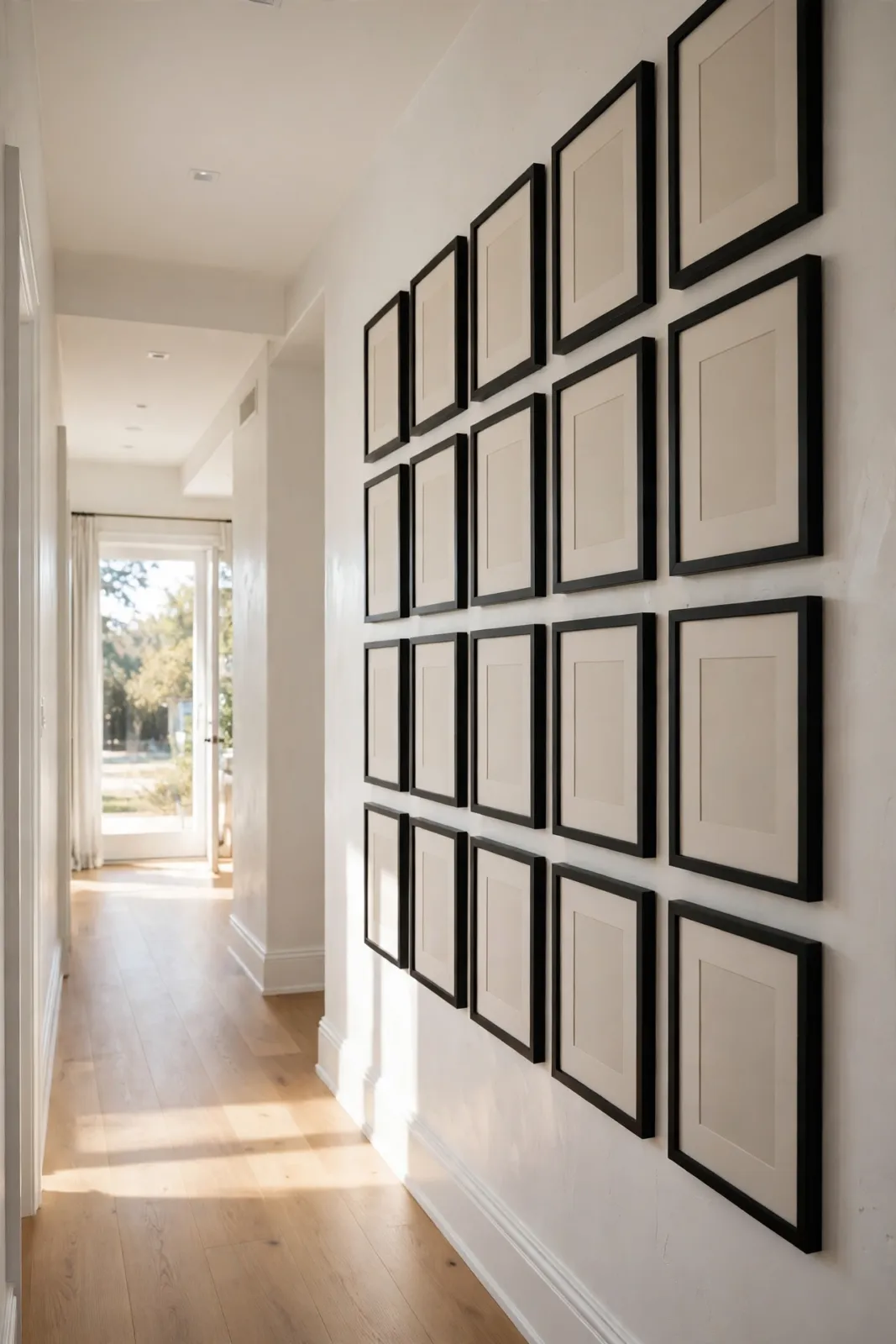
Same-size frames, same spacing, two or three rows. A grid suits hallways, dining rooms and anywhere the room already has pattern. Keep gaps equal — 5 to 7 centimetres — and the grid reads as architecture rather than decoration.
The centre-line salon hang
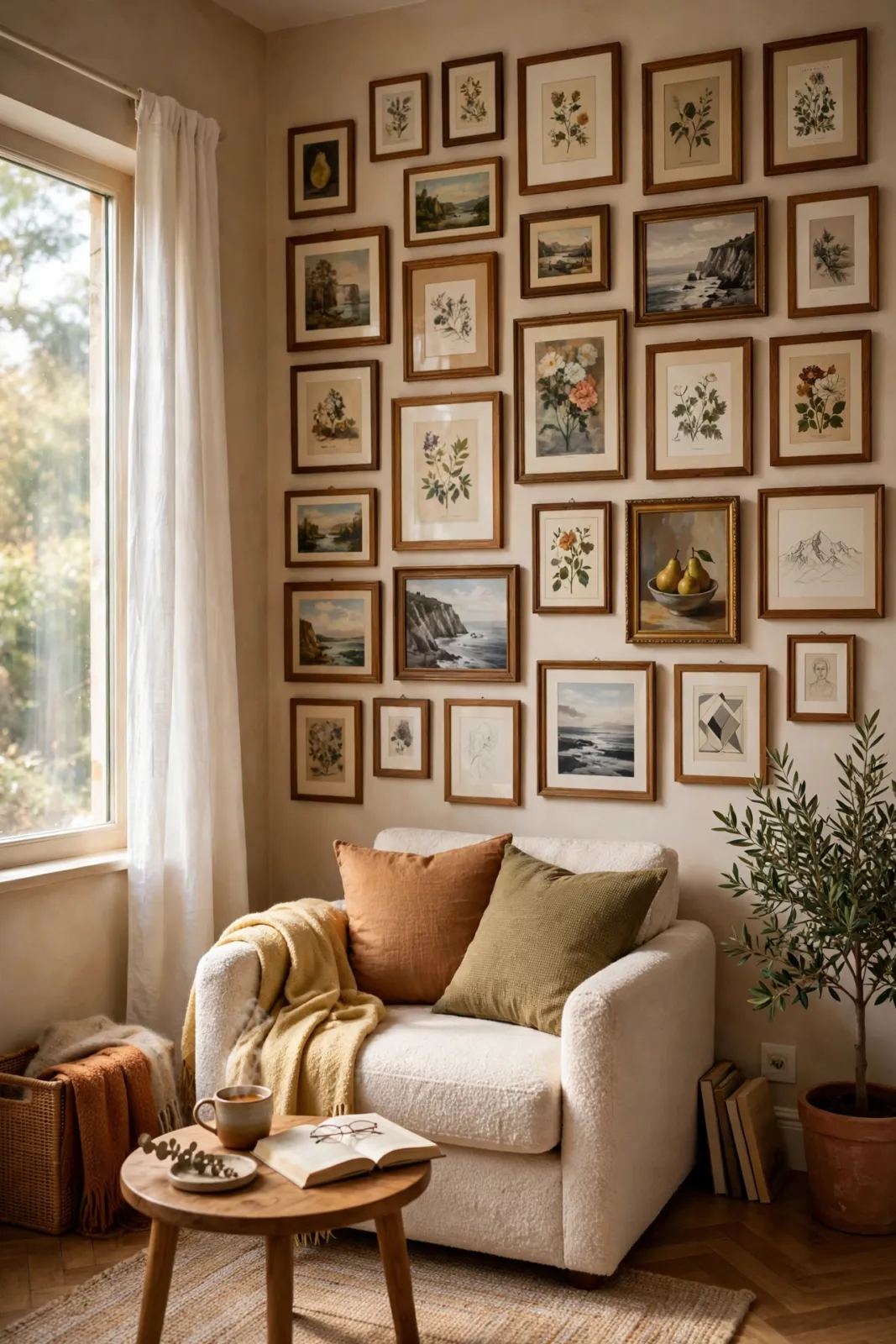
Hang the largest piece at the centre, at eye level, then build outward with smaller frames, keeping one shared horizontal line through the middle of the whole group. Salon hangs welcome mixed sizes and frame finishes while still looking planned.
The sofa-width arrangement
Above a sofa, the group should span about two-thirds of the sofa’s width and sit 15 to 20 centimetres above its back. A wider, lower arrangement connects the art to the furniture; a small cluster floating high above a long sofa always looks lost.

Ways 4 to 6: Gallery Wall Arrangement Ideas for Tricky Walls
The staircase climb
Let the bottom edge of the frames follow the slope of the stairs, keeping that diagonal consistent while sizes vary above it. Stair walls are tall and narrow, so vertical pieces and a mix that climbs steadily works better than one large horizontal group.
The hallway gallery
Long walls forgive a long, low arrangement. Keep the centre line at eye level along the whole run, repeat one frame colour for rhythm, and add a small picture light or rely on hallway lighting so the art is actually seen, not just passed.
The corner wrap
Continue the arrangement around an inside corner, keeping the corner frame slightly larger or brighter as the hinge of the composition. Corner wraps make small rooms feel considered, and they are the natural finish for the wall above a reading nook or desk.
Ways 7 to 9: Flexible Gallery Wall Arrangement Ideas
Picture ledges for changeable art
Two or three shallow ledges let you lean frames in overlapping layers and swap pieces in minutes with no new holes. Ledges suit renters, parents displaying rotating children’s art, and anyone whose taste moves faster than their drill.
The single-colour frame family
All frames in one finish — all black, all warm wood, all brass — lets wildly different art live together peacefully. This is the easiest route for beginners because the frames supply the unity while the art supplies the personality.
The mixed-media collection
Combine prints with a small mirror, a woven piece, a clock or a shallow shelf with an object. One or two non-frame elements per wall add depth and stop the arrangement reading as flat. Keep them near the centre where the eye lands first.
How to Do It, Step by Step: Gallery Wall Arrangement Ideas
The paper-template method is the professional secret: the whole layout is perfected in paper before any frame touches the wall.
- Collect every piece you might hang and lay the arrangement out on the floor, photographing two or three versions before choosing.
- Trace each frame onto kraft paper or newspaper, cut the templates out, and mark each template with the position of its hanging wire or hook.
- Tape the templates to the wall with painter’s tape in your chosen layout and live with them for a day, checking from the doorway and from seated eye level.
- Adjust gaps until they are even — 5 to 7 centimetres is the comfortable range — and keep the group’s centre at about 145 centimetres from the floor.
- Drill or hammer through the marked hook points on the templates, remove the paper, and hang the real frames in order from the centre outward.

Buying Advice That Saves Money and Regret: Gallery Wall Arrangement Ideas
Frames are the budget lever of a gallery wall. Matching inexpensive frames in one finish look far more expensive than a random mix of costly ones, and buying multiples of the same frame in two or three sizes gives you layout freedom. Choose frames with real glass or good acrylic if the wall gets sunlight, and prefer mounts — the white border inside the frame — which make small art look important and give busy pieces breathing room.
For the art itself, start with what you own: photographs printed in one consistent size, postcards, pages from an old calendar, children’s drawings and fabric offcuts all frame beautifully. Fill gaps with one or two larger prints bought slowly rather than a instant matching set, which can look like a hotel corridor. If you are also styling shelves nearby, our floating shelves styling guide on this site keeps the two from competing.
If you are also building a reading corner nearby, see our corner reading nook setup ideas for the wall above the chair.
Common Mistakes to Avoid in Gallery Wall Arrangement Ideas
- Hanging the group too high, so it floats near the ceiling disconnected from the furniture below it.
- Using gaps of different widths at random, which makes even good art look accidental.
- Hanging as you go without a floor layout or paper templates, then patching holes for weeks.
- Choosing frames that are all different in colour, depth and style with no repeating element to unify them.
- Filling every centimetre of wall, leaving no blank margin around the group — galleries need edges to read as compositions.
Frequently Asked Questions About Gallery Wall Arrangement Ideas
How high should a gallery wall be hung?
The centre of the whole arrangement should sit at about 145 centimetres from the floor, roughly average eye level. Above furniture, judge it against the piece below instead: 15 to 20 centimetres above a sofa back or console is the comfortable gap. On stairs, keep the bottom edge following the slope at a consistent height above each step.
How far apart should gallery wall frames be?
Five to seven centimetres between frames suits most walls and art sizes. Smaller pieces can sit a little closer, very large pieces a little further apart. The exact number matters less than consistency — one repeated gap across the whole wall is what makes it look designed.
How many pictures do I need for a gallery wall?
Five to nine pieces make a satisfying group above a sofa or in a hallway. Three large pieces can work as a minimal gallery if they share frames and spacing. Odd numbers are easier to arrange asymmetrically; even numbers suit grids and pairs. Start with what you have — a gallery wall is meant to grow.
Can I mix frame colours on one gallery wall?
Yes, if something else unifies them: the same mount colour, a repeated art palette, or one dominant frame finish with a few accents. Two frame finishes are easy to balance; three need care. When in doubt, paint mismatched wooden frames one colour — it is the cheapest transformation in decorating.
How do I hang a gallery wall without damaging rented walls?
Use picture ledges that need only two screws for many frames, adhesive hanging strips rated for each frame’s weight on smooth walls, or hang from a picture rail if the property has one. Always check strip weight limits and test one frame over a soft surface first, and keep heavy glass frames off adhesive alone.
A Warm Final Word on Gallery Wall Arrangement Ideas
A gallery wall is a collection, not a purchase — it should look like your life, gathered frame by frame. Start with the paper templates this week, hang the centre piece first, and let the wall grow at the speed of the things you love.