It started with one thin gold bangle my grandmother gave me, the kind that slips over your hand with a soft click and then never really leaves your wrist. I wore it alone for years. Then one birthday I added a second, slightly hammered one, and something changed. Two bangles moved together, caught the light together, and suddenly my plainest jumper looked finished. By the following winter I had five, and I understood what jewellery lovers have always known: a single bangle is pretty, but a layered stack is personal.
Layered gold bangles work because they are built, not bought in one go. Each one can mark a trip, a promotion, a new baby, or simply a Tuesday when you wanted something that felt like you. They suit a white shirt and jeans as easily as a wedding outfit. Below are nine easy ways to layer slim gold bangles for everyday shine, plus a step-by-step stacking method, buying and budget advice, common mistakes, and answers to the questions readers ask me most.

Ways 1 and 2: Start Simple — the Two-Bangle Base and the Classic Trio
1. The two-bangle base. If you own nothing yet, start here. One smooth, polished bangle and one with a light texture, worn together, already read as a deliberate stack rather than a single bracelet. Keep both slim, around two to four millimetres wide, so they sit flat against each other and move as a pair. This is the easiest everyday version: it works at a desk, it does not catch on knitwear, and it goes with every metal already in your jewellery box.
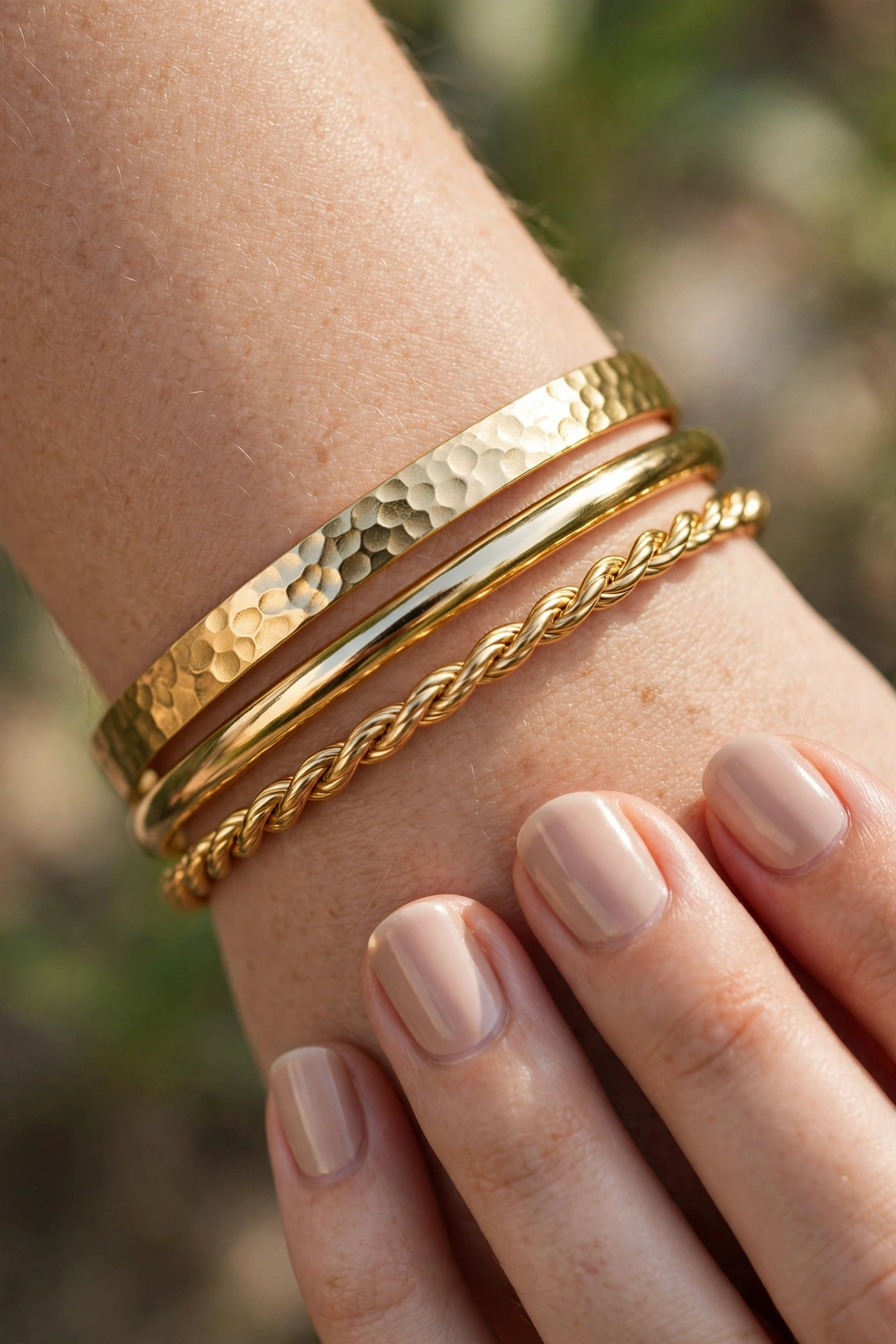
2. The classic trio. Three slim bangles are the sweet spot for most wrists. Try smooth, hammered, and twisted finishes in the same warm gold tone. The mixed surfaces make the stack interesting up close, because each one throws light differently when you turn your hand. A trio feels complete without feeling loud, and it is the stack I recommend for the office. If your wrist is larger, one slightly wider bangle in the middle anchors the set beautifully.
Ways 3 and 4: Mix Widths, Then Add One Statement Piece
3. Mixed widths for depth. Once the base feels easy, vary the widths: two very fine bangles, one medium, and one a touch wider. The rhythm of thin and thick stops the stack from looking like a uniform set, which is exactly the charm of layering. Place the widest bangle in the middle or nearest your hand, and let the finest ones sit higher on the wrist where they can move a little. Movement is part of the look, so a stack that shifts softly as you gesture is a stack that is working.
4. One statement bangle plus slim companions. A single wider cuff, an engraved bangle, or a bangle with a small stone can carry the whole stack if you frame it with slim plain ones. The statement piece goes in the centre, and the slim bangles on either side stay quiet. This is my favourite evening version, and also the kindest way to wear an inherited bangle — surrounded and shown off by simpler neighbours.
Ways 5 and 6: Pair With a Watch, or Split Across Both Wrists
5. Bangles with a watch. A classic gold or two-tone watch loves company. Wear two or three slim bangles on the same wrist, just above the watch face, and let them frame it. Keep the bangles plain if your watch is detailed, or add one textured bangle if the watch is minimal. One caution: hard bangles can scratch a watch case over time, so if your watch is precious, wear the bangles on the other wrist instead.
6. Split the stack across both wrists. Five or six bangles on one wrist can feel like a lot, but three on one wrist and two on the other looks balanced and modern. Asymmetry is the point, so do not mirror the sides exactly. Your writing hand stays lighter, and I use this version with sleeveless dresses, where bare arms give both stacks room to be seen.

Ways 7, 8 and 9: Colour Play, Charms, and Seasonal Stacks
7. Mix gold tones gently. Yellow gold with a single rose gold bangle, or one white gold piece in a yellow stack, adds a quiet twist that people notice without being able to name it. Keep the mixed tone to one or two pieces so the stack still reads as gold overall. This is also the easiest way to blend bangles from different years and makers, whose gold shades are rarely identical anyway.
8. Add one charm or chain bracelet. A fine gold chain bracelet or a single small charm threaded onto one bangle breaks up the round shapes and adds softness. Keep it to one non-bangle piece per wrist, or the stack loses its clean lines. A tiny initial, a small pearl, or a plain disc charm works best — something flat that will not snag sleeves.
9. Build a seasonal stack. In summer, go lighter: three fine bangles with bare arms and linen. In winter, go richer: five bangles pushed just above a knit cuff, where gold against wool looks warm and deliberate. Rotating pieces with the season keeps older bangles in use rather than forgotten in a drawer.

How to Build a Balanced Stack, Step by Step
Step 1: Measure your wrist honestly. Bangles must slip over your hand, so squeeze your thumb toward your little finger and measure around the widest part of your hand. A bangle that fights its way on will fight its way off, and one far too big will bang against desks all day.
Step 2: Choose your anchor. Pick the bangle you love most — the widest, the oldest, or the one with texture — and build around it. Every good stack has a centre of gravity.
Step 3: Add contrast, one piece at a time. Next to a smooth anchor, add texture. Next to texture, add shine. Put each new bangle on, look at your wrist in daylight, and only then decide on the next one.
Step 4: Check the total width. As a guide, a combined stack width of about two to three centimetres suits most wrists for everyday wear. More than that starts to limit how freely your wrist bends, which is your sign to split the stack across both wrists instead.
Step 5: Live in it for a day. Type, cook, carry a bag, push up your sleeves. If one bangle keeps spinning to the front or catching, move it higher in the stack or rest it for a week.

Buying, Budget, and Care Advice
You do not need solid gold everything, but it helps to know what you are paying for. Solid gold costs the most and lasts generations. Gold vermeil and good quality gold-filled pieces give a similar warmth for far less, and are a sensible way to test how many bangles you actually enjoy wearing. Thin hollow bangles are light and affordable but dent more easily, so save those for the higher, quieter positions in the stack.
On budget, buy slowly: one well-made smooth bangle first, one textured, then widths and tones as occasions come along. A stack collected over two years looks richer than a boxed set bought in one afternoon. Whatever the material, check each bangle is smoothly finished inside, with no rough edge — you will feel a rough bangle a hundred times a day.
For care, warm water, a drop of mild soap, and a soft cloth keep everyday shine. Take bangles off for swimming pools and cleaning sprays, since chlorine dulls the surface over time. Store them in a soft pouch rather than loose in a drawer, where harder stones can scratch them.
Common Mistakes to Avoid
The most common mistake is wearing five identical bangles in identical widths. Without contrast, the stack reads as one wide cuff from a distance and you lose the whole point of layering. The second mistake is sizing up too far: oversized bangles clatter, bruise the side of the hand, and chip against hard surfaces. Third is ignoring your sleeves — wide stacks fight with tight cuffs, so match the stack to the outfit. Fourth, mixing too many statement pieces at once; one anchor and quiet companions always look more expensive. Finally, do not force a bangle over your hand every morning. If it hurts going on, it is the wrong size.
Frequently Asked Questions
How many gold bangles should I wear at once?
Three is the classic everyday number and suits almost every wrist and workplace. Two looks minimal and neat, while five makes a fuller, more festive stack. Let your wrist size and your sleeves guide you: if the stack stops your wrist bending comfortably, it is one bangle too many.
Can I mix gold bangles with silver or rose gold?
Yes, and mixed metals are one of the easiest ways to make a stack feel personal. Keep one metal clearly in charge, usually gold, and let the second tone appear in just one or two pieces. Repeating the guest tone in a ring or earrings helps the mix look planned.
Do layered bangles suit small wrists?
They suit small wrists very well, as long as the bangles themselves are slim and correctly sized. Choose narrower widths, keep the stack to two or three pieces, and avoid very wide cuffs, which can overwhelm a fine wrist. A smaller stack worn often beats a big stack left at home.
Will bangles damage each other when they rub together?
Gold bangles do touch and move against each other, and over years that gentle contact can soften sharp edges and add tiny surface marks. Most wearers consider that patina part of the charm. If you want to slow it down, alternate a textured bangle between smooth ones and store the stack in a soft pouch.
Can I wear layered bangles to work?
Absolutely. A slim trio in matching tones looks polished with shirts, knitwear, and blazers, and it is far quieter than people expect. If your job involves constant typing, wear the stack a little higher on the wrist or choose the smoothest finishes, which glide over a desk without a sound.
A Small Stack With a Long Story
Layered gold bangles are the rare trend that is not really a trend at all. They ask for patience instead of a shopping spree: one good bangle, then another, then the one you did not plan but could not leave behind. Start with two, learn what your wrist likes, and let the stack grow at the speed of your life.