Table of Contents
Every home has one cupboard that defeats it. You fold everything beautifully on laundry day, and two weeks later the linen cupboard is a soft landslide of sheets, pillowcases and towels that fall on your head when you reach for the top shelf. A simple linen cupboard folding method ends that cycle. It is not about buying baskets or labels first. It is about folding every piece to the same finished size, storing sheet sets as single bundles, and putting things back in an order that survives real life. Once the method is in place, the cupboard stays neat almost on its own, because every item has one obvious shape and one obvious home.
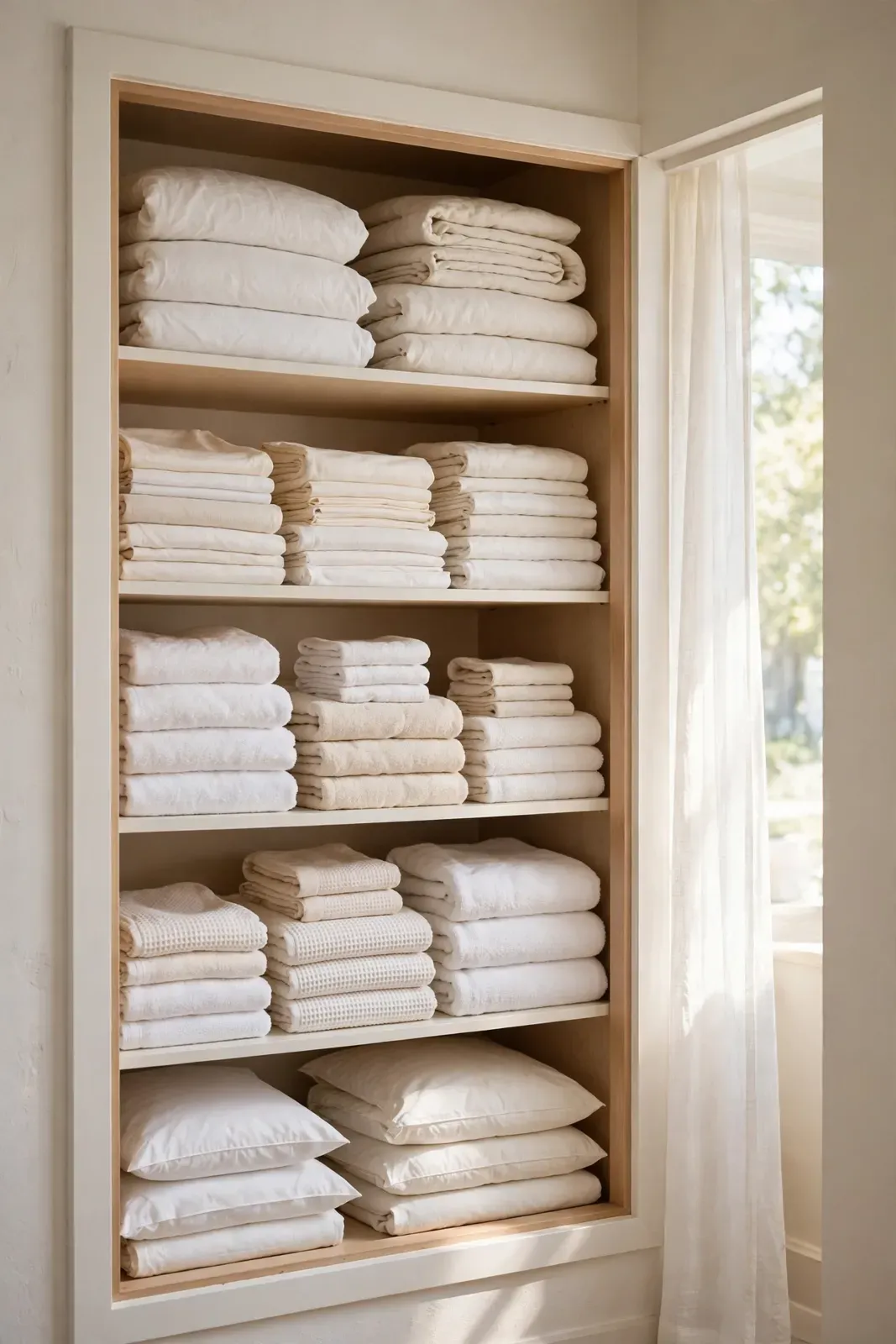
The Core Idea Behind the Linen Cupboard Folding Method
Most linen cupboards fail for one plain reason: every piece is folded to a different size. A king sheet folded in quarters, a single sheet folded in thirds and a towel folded however it came off the line can never stack into a stable tower. Mixed sizes lean, slide and slowly pull the whole pile apart. The fix is to choose one finished rectangle for sheets and one for towels, based on your shelf depth, and fold absolutely everything to those two sizes. That is the heart of the linen cupboard folding method: remove the guesswork, and the stacks behave.
Measure your deepest shelf first. For most cupboards, a finished fold of roughly 25 by 35 centimetres for sheets and 20 by 30 for towels sits flat, fills the depth without overhanging, and stacks four to six high without wobbling. If your shelves are shallow, fold one step smaller rather than letting edges stick out, because overhang is where piles start to slump. The fabric itself helps you: true linen and cotton both take a crisp fold and hold it, which is why the same method looks tidy for weeks instead of days. A linen cupboard folding method only works when those two sizes never change.
How to Fold Flat Sheets and Fitted Sheets the Same Way
Start with the flat sheet, because it sets the pattern. Lay it flat, fold it in half lengthways, then in half again, smoothing as you go. Fold the long strip into thirds, pressing out air with your hands at each turn. You should end with the standard rectangle. A bed sheet folded this way has no loose corners, and loose corners are what unravel stacks from the middle. Treat every sheet this way, and the linen cupboard folding method becomes muscle memory within a fortnight.
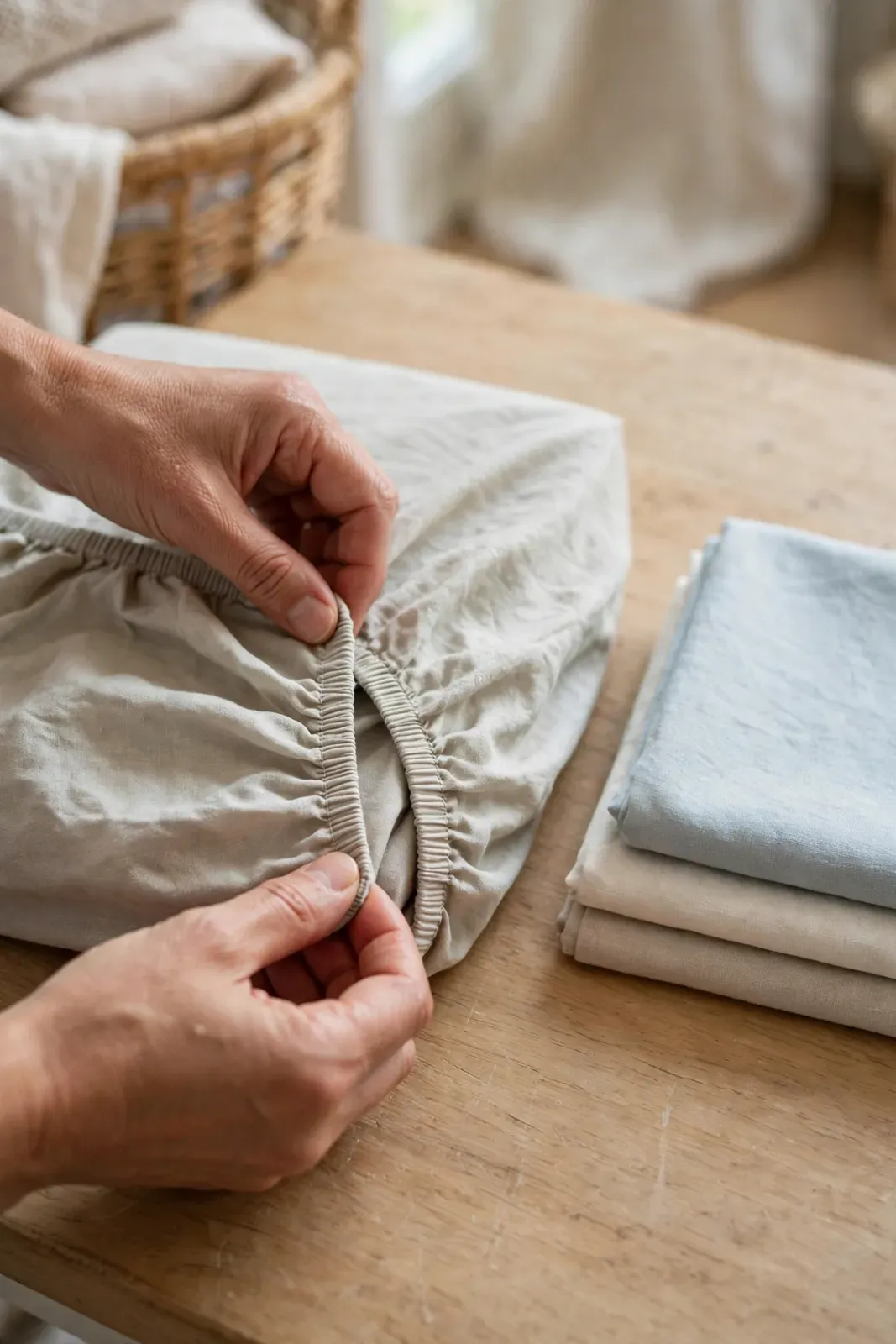
The fitted sheet is the one everyone dreads, but it folds to the exact same rectangle with one extra move. Put a hand inside each top corner, bring the corners together so one tucks inside the other, and repeat at the bottom so all four elastic corners nest into one. Lay the sheet down and you will see an L or a rough rectangle with one curved elastic edge.
Fold that curved edge straight across to hide the elastic, then fold exactly like the flat sheet: in half, in half, and into thirds. The first two attempts will look lumpy. The third will not, and from then on your fitted sheets stop being the cupboard’s problem item. With that one extra move, the linen cupboard folding method tames the sheet everyone used to dread.
Bundle Every Sheet Set Inside Its Own Pillowcase
This is the step that changes everything. Instead of storing sheets, duvet covers and pillowcases in three separate piles that never match when you need them, store each complete set as one bundle. Fold the sheet and the duvet cover to the standard rectangle, fold one pillowcase the same way, stack all three, and slide the whole stack inside the second pillowcase. Fold the open end of the pillowcase under, and you have a soft parcel that holds its own pieces together.
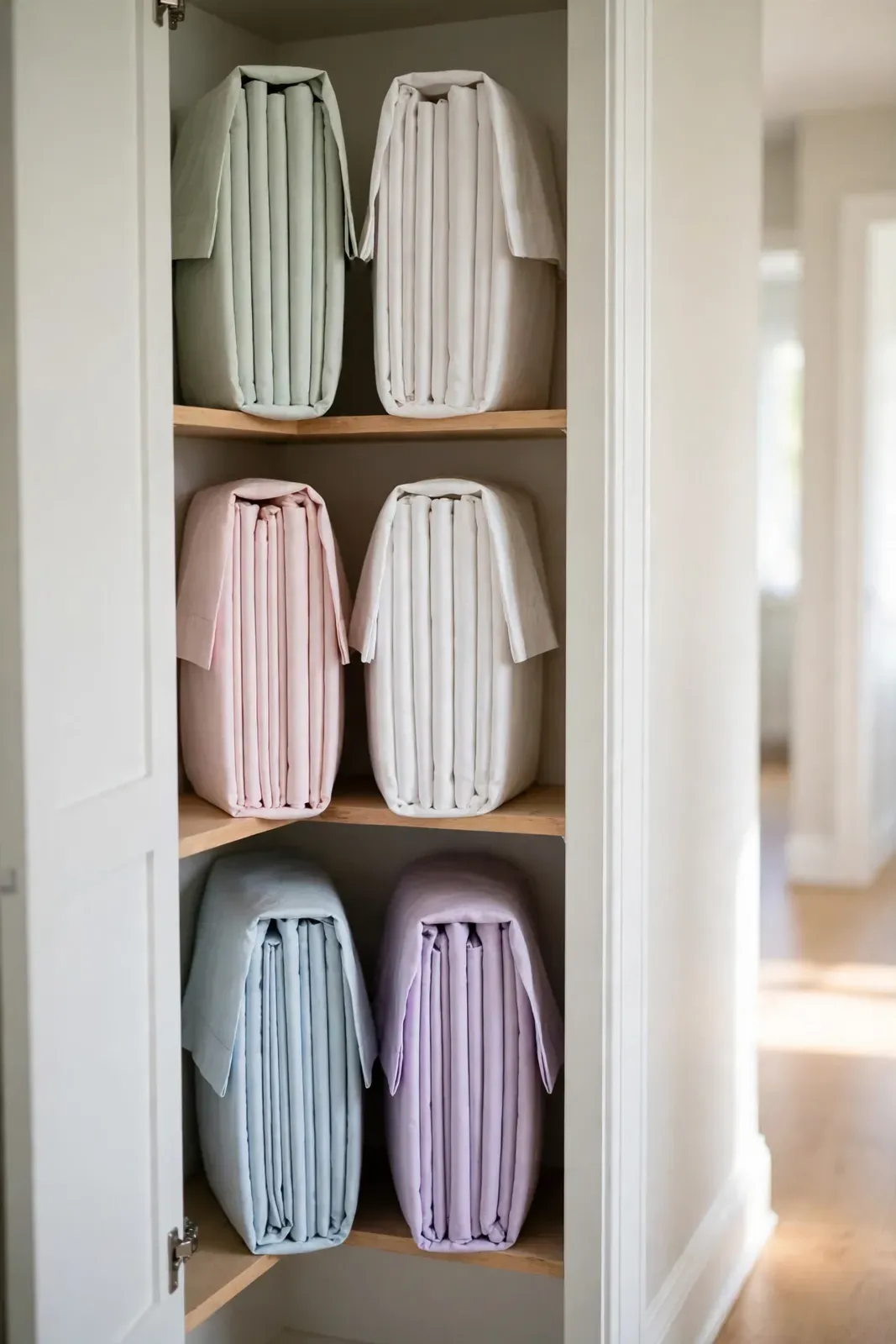
Bundles can stand upright on the shelf like files, which is better than stacking for two reasons. You can see every set at a glance, in its own colour or pattern, and pulling one bundle out never disturbs the others. Changing a bed stops being an archaeology project: one bundle off the shelf has the sheet, the cover and both pillowcases, every time. Guest bedding becomes one bundle per guest bed, kept at the front where tired hosts can find it in the dark. This is why the linen cupboard folding method stores the set, not the single piece, as the unit that goes on the shelf.
Towels: One Fold for Bath, One Rule for Hands
Towels follow the same logic. Fold bath towels to the second standard rectangle: in half lengthways, in half again, then in thirds. Stack them no more than five high, because a taller towel tower leans under its own softness. Hand towels and face cloths fold to half that size and get their own small stack beside the bath towels, never mixed into them. The linen cupboard folding method keeps the two towel sizes separate for exactly the same reason.
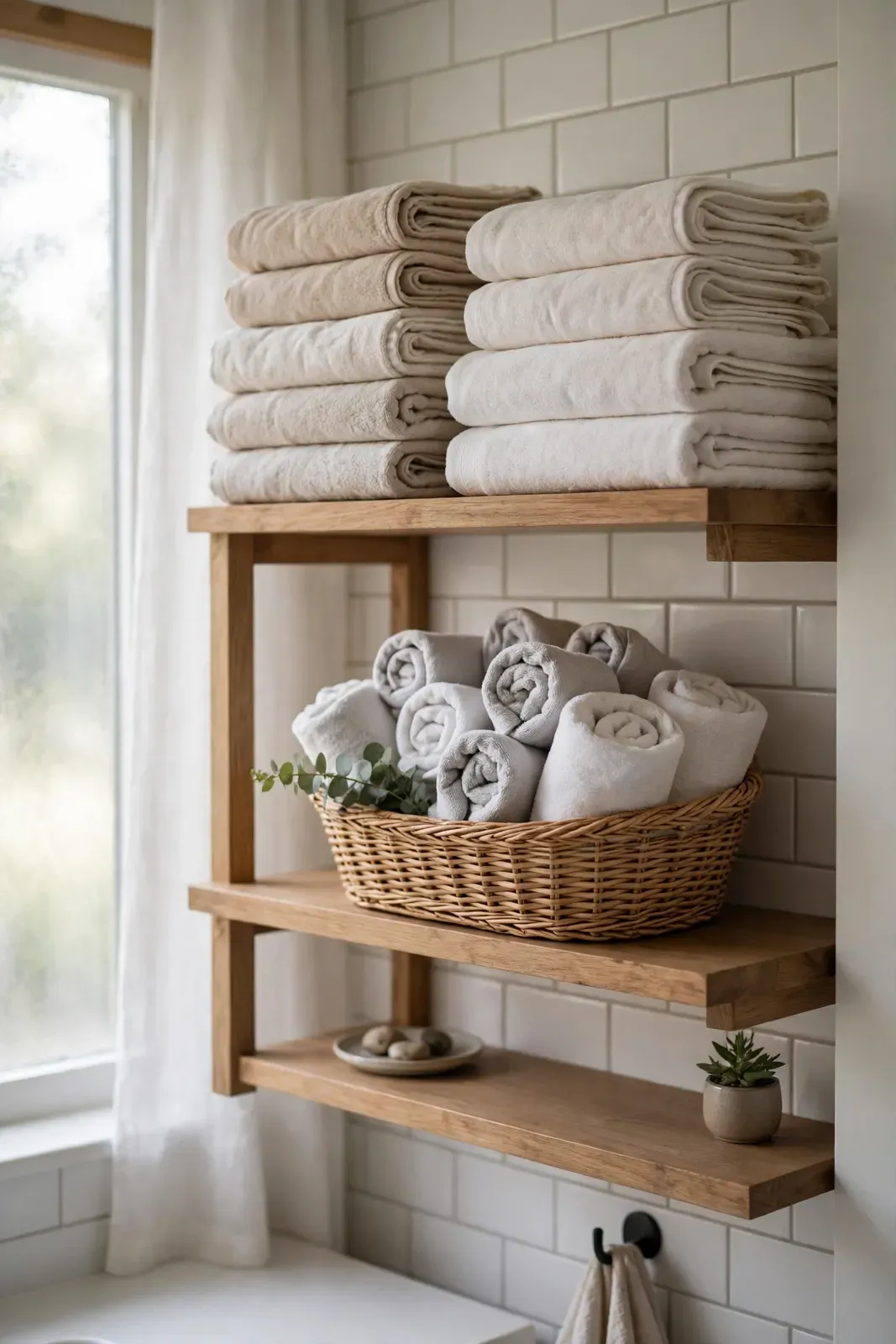
Rolled towels look lovely in a guest bathroom basket, and rolling genuinely works for display. Inside a working family cupboard, though, flat folds win: they hold more per shelf, they stack, and a rolled towel taken from the middle of a basket unpacks its neighbours. Keep one rolled set for guests if you enjoy the look, and let the everyday stock stay flat and boring. Boring is what stays neat. It is the one display exception the linen cupboard folding method allows, because guests see those towels first.
Your Linen Cupboard Folding Method: Step by Step
Step 1 — Empty and sort honestly. Take everything out. Keep two or three sheet sets per bed and no more; extra sets are what overcrowd the shelves and crush the folds. Towels with frayed edges move to the cleaning cupboard, where they will be used hard and appreciated.
Step 2 — Set the two standard sizes. Measure the shelf depth, decide the sheet rectangle and the towel rectangle, and fold one of each as your samples. Keep the samples on top while you work so every fold that follows matches them. The linen cupboard folding method depends on never guessing those two sizes.
Step 3 — Fold and bundle the sets. Work bed by bed. Fold each set, bundle it inside its spare pillowcase, and stand the bundles upright by bed size: doubles together, singles together, guest sets at the front.
Step 4 — Zone the shelves. Give each shelf one job: sheet bundles on one, bath towels on another, hand towels and cloths on a third, and spare blankets or duvets on the top shelf where their weight cannot crush anything. The same one-job-per-zone thinking keeps our small living room layout ideas working, and it works in a cupboard for the same reason: nothing has to be moved to reach something else.
Step 5 — Refold on return, every time. The method only survives if laundry comes back folded to the standard sizes. It adds perhaps a minute per load, and it is the whole secret. A cupboard is not organised once; it is organised at the speed of the laundry basket.

Budget Advice: What Helps and What Is a Waste
The honest news is that this method costs almost nothing. The one purchase that genuinely helps is a set of simple shelf dividers or two low baskets, one for face cloths and one for the small odds and ends — spare buttons in their envelope, a sewing kit, the good stain remover — that otherwise drift between piles. A lavender bag or a scrap of scented soap paper per shelf keeps stored linen fresh for pennies. Everything else the linen cupboard folding method needs is probably already in the house.
Skip the matching designer storage boxes, which waste shelf depth with their own walls, and skip vacuum bags for everyday linen: they crush folds flat, crease cotton hard, and turn bed-making into a wrestling match. Save the money toward one better sheet set when an old one wears out. Fewer, better sets fold better, last longer and keep the cupboard emptier, which is the real luxury. A leaner shelf is exactly what the linen cupboard folding method is designed to protect.
Common Linen Cupboard Mistakes to Avoid
First, storing sets in separate piles, which guarantees mismatched hunting at bedtime. Second, stacking too high: six folded sheets is a pile, ten is a landslide waiting for a witness. Third, putting linen away even slightly damp, which fills the whole cupboard with a stale smell within a week; an extra hour on the line or the airer is always worth it.
Fourth, using the linen cupboard as general storage for medicines, batteries and gift wrap — every foreign object steals fold space and breaks the one-job shelves. Fifth, folding straight from the tumble dryer in a heap to “sort later”. Later never comes, and the creases set like concrete. Each of these quietly undoes a good linen cupboard folding method, so run through them before you close the cupboard door.
Frequently Asked Questions
How many sheet sets should I actually keep per bed?
Two is enough for most homes and three is generous: one on the bed, one in the wash or folded ready, and a spare for guests or accidents. More than three per bed is usually what makes the cupboard impossible, because the extra sets crush the folds of everything else. That limit is part of what makes the linen cupboard folding method sustainable week after week.
How do I stop fitted sheets looking lumpy?
Nest the four elastic corners into each other first, then fold the curved edge straight across before you start the standard folds. The lump is almost always trapped air and loose elastic; smooth each fold with your palm and the finished rectangle comes out as flat as a flat sheet. Patience at this step is what makes the linen cupboard folding method look effortless later.
Should towels be rolled or folded in a family cupboard?
Folded, for everyday use. Flat folds stack, hold more per shelf and survive one towel being pulled from the middle. Rolling suits a guest basket or a display shelf where the towels are decoration first and equipment second. That is the linen cupboard folding method rule: display may roll, but storage folds flat.
How do I keep stored linen smelling fresh?
Only store linen bone dry, leave a finger’s width of air between stacks so the cupboard can breathe, and add a lavender bag, a cedar block or a wrapped bar of soap on each shelf. If a stale smell has already settled in, wash the affected sets with a cup of white vinegar in the rinse and dry them outdoors. Freshness, like neatness, is a habit the linen cupboard folding method quietly builds in.
What do I do with a very deep cupboard where bundles get lost?
Stand bundles in two rows and keep a simple rule: everyday sets in the front row, guest and seasonal sets behind them. If the depth still defeats you, one shallow basket per row, pulled out like a drawer, restores order without any building work.
A neat linen cupboard is not a personality trait; it is a folding habit with two fixed sizes and one bundling trick. Set it up once on a quiet afternoon, refold to the standard every laundry day, and the soft landslide never forms again. Bedtime changes get faster, guests get matching sets, and the cupboard door opens without anyone bracing for falling towels. That, in one habit, is the linen cupboard folding method at work.