I found my first small silk scarf in the bottom of a drawer, folded into a neat square and still holding a faint trace of my mother’s perfume. It was petite, barely 50 centimetres across, in soft blush pink. One morning, late for coffee, I tied it at my neck over a plain cream blouse, mostly to hide a missing button. By the time I sat down, my friend had asked where it was from, and a woman at the next table had smiled and pointed at it too. That little square has been in regular rotation ever since.
That is the quiet charm of a petite silk neck scarf. It does not shout. It finishes an outfit neatly, with a little personality left over. If you have one in a drawer, or have been eyeing one and wondering whether you would wear it, this guide walks through nine ways to tie it, the knots worth learning first, how to choose good silk, and how to wash it safely.

Why the Petite Size Works So Well at the Neck
Size is the first thing people get wrong. A large 90-centimetre scarf is lovely over shoulders, but bunched at the neck it creates bulk, heat, and a knot the size of a small fist. A petite scarf, usually 50 to 55 centimetres square, gives just enough fabric for a clean knot and two short, tidy tails. Nothing flaps, and the proportion suits smaller frames especially well.
Silk matters too. It feels cool in summer and surprisingly warm in a chilly office, and its soft sheen makes even a plain colour look considered. It also grips itself enough to hold a knot, unlike slippery polyester, which often works loose by midday. With simple tops and buttoned shirts, a petite scarf fills that empty space at the throat and gives the look a focal point.
9 Chic Ways to Tie a Small Silk Scarf at Your Neck
Here are the nine styles I reach for most, from the two-minute options to the ones that look far harder than they are.
1. The classic front knot. Roll the scarf into a band, wrap it once around your neck, and tie a simple knot at the front. Best with a V-neck or open collar.
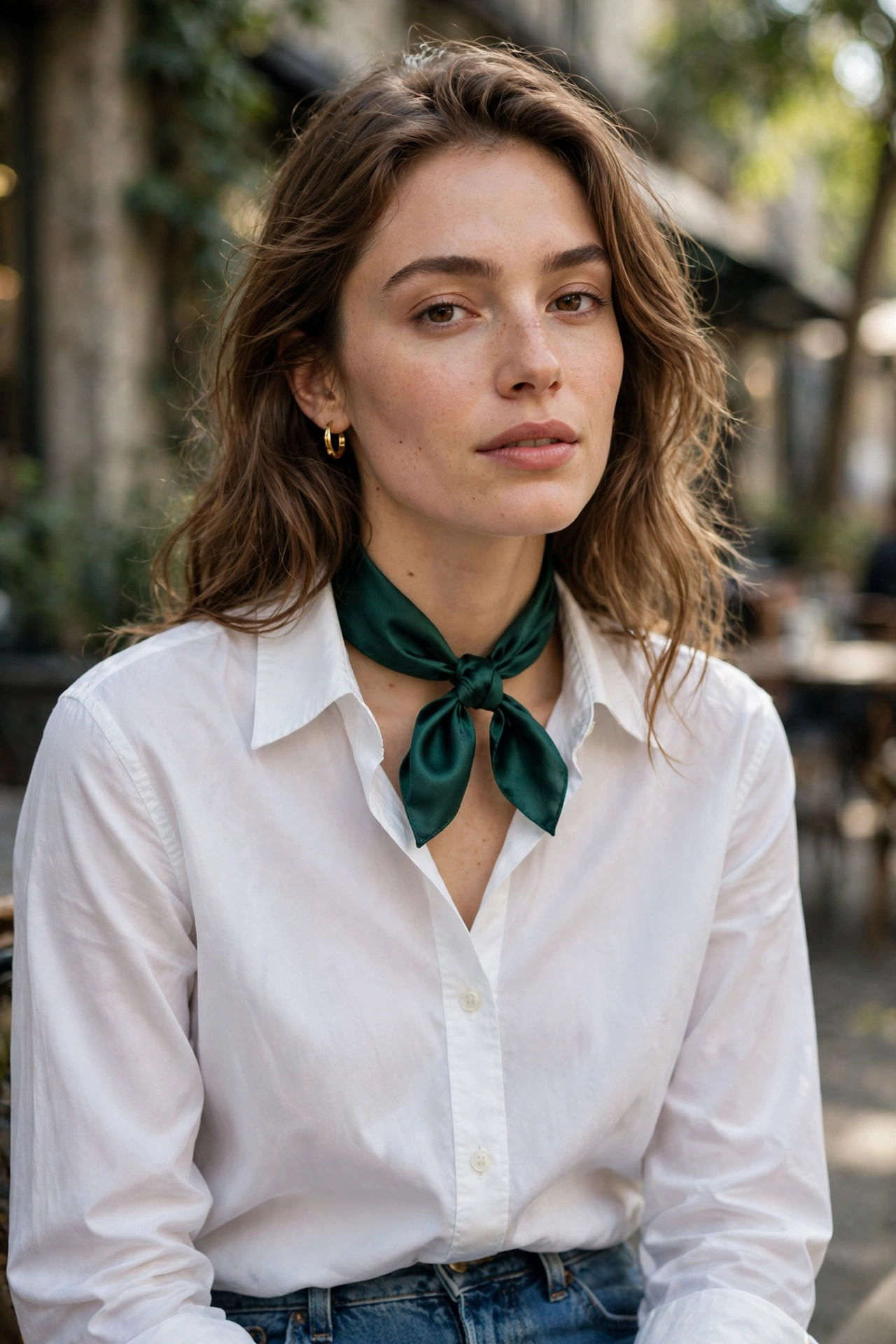
2. The petite bow. Tie a small bow just off centre. Keep the loops small — a neat bow reads polished, a big floppy one reads costume. Lovely with a plain blouse, as in the first photo.
3. The side knot. Move the knot to sit just above one collarbone. It softens a severe neckline and works beautifully with hair tucked behind one ear.
4. The choker wrap. Roll into a thin band, wrap twice snugly around the neck, and tuck the ends under at the back. Clean and good under a blazer.
5. The French twist. Place the centre at the front of your throat, cross the ends behind your neck, bring them forward, and tie a small knot over the band. This one stays put all day.

6. The loose sailor knot. Wear the triangle at the back, bring the ends forward, and tie them low and loose at the chest. Relaxed with a stripe top or tee.
7. The ascot tuck. Knot once, then tuck the tails into the neckline of a sweater so only a puff of silk shows at the throat. Warm and tidy in winter.
8. The single loop drape. No knot at all. Drape it around the neck with ends hanging unevenly, and let a cardigan or buttoned jacket hold it in place.
9. The ring finish. Thread both ends through a scarf ring and slide it up to the throat. No knot bulk, and it stops silk slipping on windy days.

Step-by-Step: Three Knots Worth Learning First
You do not need all nine on day one. Learn these three and you can handle most outfits.
The classic front knot
Step 1: Fold opposite corners together to make a triangle. Step 2: Roll it into a band about four centimetres wide. Step 3: Place the centre at the back of your neck and bring both ends forward. Step 4: Cross right over left, pull up through the loop, and repeat for a square knot. Step 5: Sit the knot at the hollow of your throat and puff the points apart. The close-up above shows the finish — snug, small, and smooth.
The petite bow
Step 1: Make the same rolled band, with the left end a little longer. Step 2: Tie one simple knot at the front. Step 3: Fold the longer end into a small loop. Step 4: Wrap the shorter end around it once and tuck it through the gap behind to form the second loop. Step 5: Pull both loops even, keeping them no wider than your jaw. If the bow droops, your band was too wide — roll it narrower and retie.
The French twist
Step 1: Fold into a triangle with the point at the back. Step 2: Cross the long corners at the front of your throat, take them behind your neck, and cross again. Step 3: Bring the ends forward and tie a half knot over the front band. Step 4: Tuck extra length under the band. The double cross is why it feels secure without being tight.
Choosing Colours and Pairing Your Scarf With Clothes
Start with what you already wear. If your wardrobe leans neutral — cream, navy, grey, denim — one patterned scarf with three or four colours will pair with almost everything, because folding it differently brings a different colour forward. If you wear a lot of prints, do the opposite and choose solids: emerald, burgundy, navy, and soft blush cover most seasons.
A few pairings that rarely fail: a patterned scarf with a navy blazer and white top for work, as shown below; emerald with a white shirt and jeans; a pale floral scarf with a plain summer dress; and deep red with a black crew neck in the evening. Keep other accessories quiet when the scarf has a print — small studs or thin hoops are enough.

Buying Advice: How to Spot Good Silk
Check the label first. You want 100 percent silk, ideally mulberry silk. A weight of 16 to 19 momme is a sweet spot: light enough to knot neatly, substantial enough not to feel flimsy. Hold it to the light — good silk has a living sheen that shifts as you move it, not a flat plastic glare. It should feel smooth and slightly warm, not squeaky.
Look at the edges. Hand-rolled hems, softly rounded, are a sign of care and help the scarf roll without a hard ridge. Prints should show almost as clearly on the back as the front; a very pale back usually means a cheaper print. For neck tying, 50 to 55 centimetres is ideal — bigger is just more fabric to wrestle with.
Care and Washing: Keeping Silk Soft and Bright
Silk asks for five calm minutes, not a machine cycle. Fill a basin with lukewarm water and a few drops of gentle detergent. Swish the scarf slowly for two or three minutes — do not wring or scrub, press gently instead. Rinse until the water runs clear. Roll it in a clean towel to remove water, then lay it flat in shade. Direct sun fades silk, and a hot radiator makes it brittle.
Iron on the lowest silk setting while it is still slightly damp, or use a steamer held a short distance away. Store it flat or loosely rolled, not hanging from a hook, which can pull it out of shape. Spray perfume first, let it dry, then tie your scarf. With this routine, a good petite scarf lasts for years.

Common Mistakes to Avoid
The most common mistake is tying too tightly. You should slide two fingers under the band comfortably; anything snugger will annoy you within the hour and crease the silk. Second, folding the band too wide, which makes a bulky knot — a narrow roll looks better. Third, matching the scarf exactly to your top, which makes it disappear; choose a contrasting colour or a minor shade in your outfit. Fourth, wearing a busy scarf with a busy print and large earrings at once — pick one focal point. And do not give up after one crooked try in the mirror. Roll it narrower and retie; the second try usually lands.
Frequently Asked Questions
What size is a petite silk neck scarf?
Most petite neck scarves are square and measure about 50 to 55 centimetres on each side — enough to wrap once and tie a small knot, without trailing ends. Between sizes, choose the smaller one for neck styles.
Will a silk scarf stay tied all day?
Yes, if you use a double knot or the French twist and start with a narrow rolled band. Real silk holds a knot far better than smooth polyester. A scarf ring also helps on windy days.
Can I wear a neck scarf to work?
Certainly — it is one of its best uses. A small scarf knotted at the neck adds colour to a blazer, shirt, or plain dress without breaking most dress codes. Keep the knot neat and tails short.
How do I stop a silk scarf slipping on my hair or neck?
Slipping usually means the band is too wide or tied too loosely at the first cross. Roll it narrower, cross firmly behind the neck in the French twist, and finish with a double knot. Avoid tying silk over freshly applied body lotion, which makes it slide.
How often should I wash a silk neck scarf?
Wash it after several wears, or sooner if it picks up makeup at the fold that touches your skin. Silk does not need washing after every outing; airing it flat overnight is often enough.
A Small Square, a Lot of Use
My blush scarf no longer lives in the bottom of a drawer. It lies rolled near the door, next to my keys, because I reach for it that often. That is the test of any accessory: not how striking it looked in the shop, but how many ordinary mornings it quietly improves. Pick one knot this week, wear it with the plainest top you own, and notice the difference. Then try the bow, then the twist. A petite silk scarf asks very little — a drawer corner and five minutes of gentle washing now and then — and gives back a finished look almost every day. That seems like a fair trade to me.