Good ironing board hidden storage ends the daily battle with the most awkward object in the home. An ironing board is too long for most cupboards, too wide for the gap beside the washing machine, and it has a habit of sliding down the wall with a crash at two in the morning. Most of us lean it somewhere and work around it for years.
Good ironing board hidden storage ends that arrangement. The board, the iron, the spray bottle and the spare cover all live in one planned spot, out of sight, and come out in one motion when pressing day arrives. This guide walks through the storage types that actually work, where to put them in small and large homes, and how to set one up step by step.

Table of Contents
Ironing Board Hidden Storage: The Main Types That Work
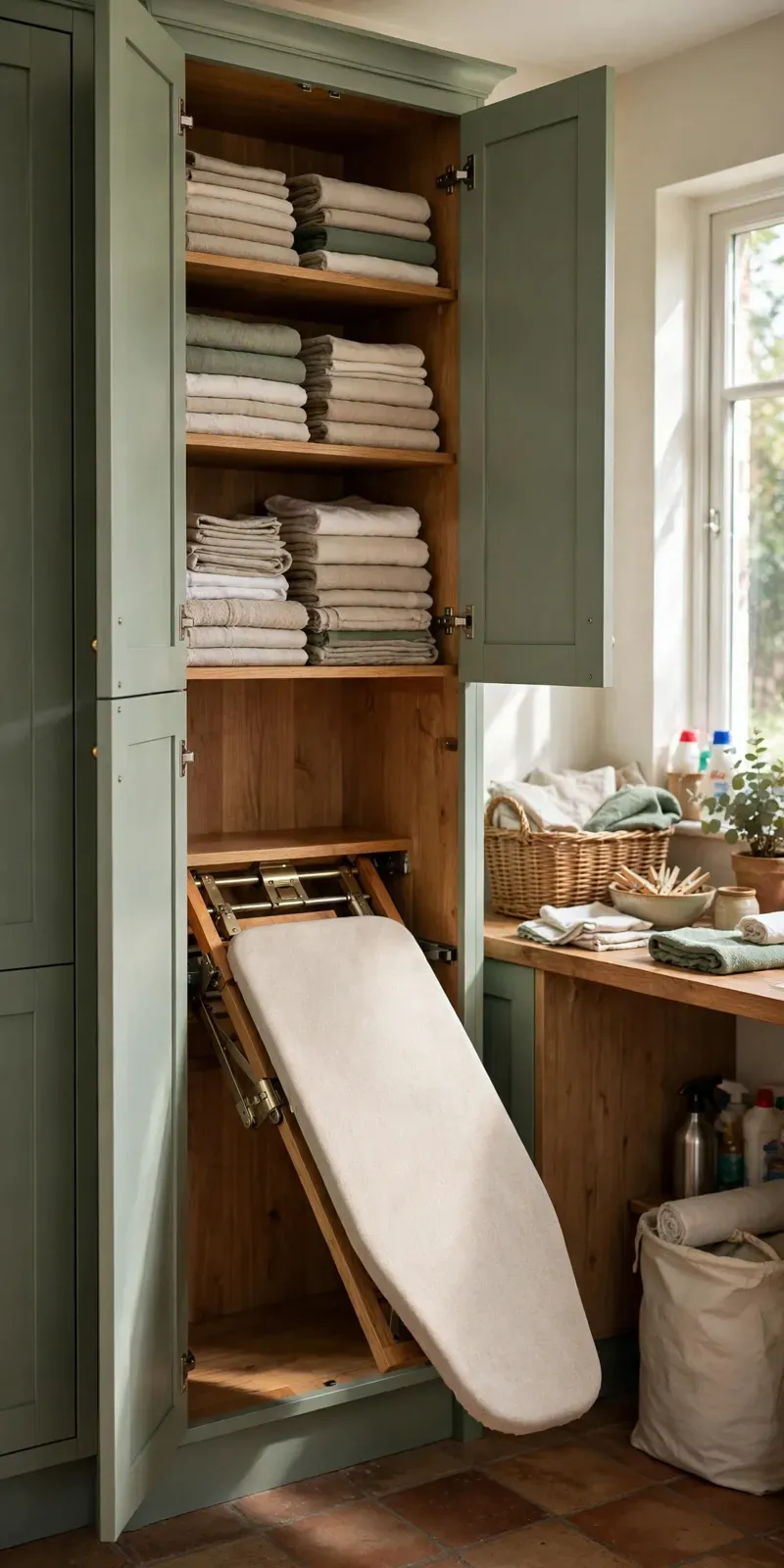
The classic answer is the wall cabinet: a shallow cupboard, often no deeper than a hand span, with the board folded flat inside it. Many designs let the board pivot down from the cabinet itself, so you open the door and pull the board straight into working position. It is the neatest version of ironing as a household task with its own equipment and routine, because everything returns to the same closed box afterwards.
Wall cabinets suit a laundry room, a wide hallway, or the side wall of a kitchen where a shallow unit does not block the walkway. It is ironing board hidden storage at its simplest.
The second type hides the board in a drawer. A deep kitchen or utility drawer can hold a purpose-built fold-down board that lifts and unfolds over the drawer front; when the drawer closes, the worktop above it is completely clear.
The third type is a slim pull-out in the gap beside the washing machine or inside a tall laundry cupboard, standing the board upright on its long edge. The fourth, and cheapest, is a planned tall slot: a narrow section inside an existing wardrobe or airing cupboard, with a hook for the iron and a small shelf for bottles, so the board has a home instead of a leaning place. Each route is a different form of ironing board hidden storage, and the best one is the one that fits the room you have.
Choosing the Right Spot in Your Home
Store the board where you actually press. A perfect cabinet in a spare room you never use will quietly fail, because nobody carries a board and a basket of laundry up the stairs for three shirts. Most people iron in the laundry area, the kitchen, or the main bedroom, and the storage should sit within a few steps of that spot, near a socket for the iron and near the rail or surface where finished clothes hang. That is the first rule of ironing board hidden storage: store it where the pressing happens.
Measure three things before choosing a type. First, your folded board: length, width across the legs, and thickness, because cabinets are built around standard sizes and an older wide board may not fit. Second, the wall or cabinet space: a wall unit needs a clear swing area in front of it so the board can fold down without hitting a door or a shelf.
Third, the stud or fixing points, because a loaded cabinet holding a board and an iron must be fixed into solid structure, never into plasterboard alone. Renters should look at the tall-slot and door-hook options, which need no drilling at all.

Step by Step: Setting Up a Wall Cabinet Station
Step 1: Mark the working height. Stand where you will press and mark the wall so the board, once folded down, sits at your usual ironing height, roughly hip height. Most cabinet boards pivot from a fixed point, so this measurement decides everything else.
Step 2: Fix the cabinet to structure. Find the studs or use masonry fixings, level the cabinet, and fix it at the marked height. Hang on it briefly with steady pressure; it should feel like part of the wall.
Step 3: Load it in order. Board first, then the iron in its heat-safe rest or holder, then spray and starch on the small shelf, then the spare cover folded flat. Everything should be reachable without moving anything else.
Step 4: Route the cord. Fit a simple cord hook or clip inside the door so the iron’s cord coils in one place instead of tangling around the board legs.
Step 5: Test the full routine. Open, unfold, press one shirt, fold away and close. The whole cycle should take under a minute at each end; if it takes longer, adjust the order of the contents until it does not. When that cycle feels easy, your ironing board hidden storage is working as it should.
Small Homes and Rental-Friendly Options
Small homes benefit most from ironing board hidden storage because there is no spare corner for it to lean in. A drawer board in the kitchen suits flats where laundry happens at the kitchen table. An over-door hook on the inside of a utility or bedroom door keeps the board flat against a surface that is usually wasted.
In studio spaces, a slim tall cabinet can double as the divider between the sleeping and living zones, storage and screen in one piece of furniture. The history of laundry work moving into dedicated, planned spaces is really the story of small homes making every centimetre earn its place, and the ironing board is the last bulky item most homes have not planned for.
Whatever the size of the home, keep one rule: the board’s home must be easier than leaning it against the nearest wall. If putting it away takes two hands, a step stool and patience, it will be leaned. If it takes one motion, it will be stored. Follow that rule and ironing board hidden storage becomes a habit, not a chore.
Budget and Buying Advice
Prices climb steeply with cleverness, so buy ironing board hidden storage for your actual routine. A simple over-door hook or a planned tall slot in an existing cupboard costs almost nothing and solves the problem for most homes. A plain wall cabinet with a fold-down board sits in the middle range and is the best value for a laundry room you own.
Drawer boards and built-in pull-outs cost the most because they involve cabinetry; choose them when you are already renovating the kitchen or utility room and the joinery is being made anyway. Judge each ironing board hidden storage option by that routine.
Check three things before paying: that your board’s folded size fits (or that the included board is a full-size one, because some compact units carry a small board that makes pressing sheets miserable), that the iron rest is metal and heat-safe, and that the hinges and pivot feel solid in the showroom. A wobbly pivot only gets worse.
Keep the spare cover and a small bottle of descaler in the same storage so the whole pressing kit lives and ages together.
Common Mistakes to Avoid
The first mistake with ironing board hidden storage is storing the board far from a socket, which adds an extension lead tangle to every session. The second is a cabinet mounted too high or too low, so the board sits at an awkward pressing height and your back pays for it. Third, putting the iron away hot in a closed cabinet against fabric or wood that is not heat-safe; always use the metal rest and let the iron cool standing up.
Fourth, forgetting the cord, which then wraps around everything. Fifth, buying storage for a board size you do not own. Measure your own board first; it takes one minute and prevents the most common return. Avoid those five and ironing board hidden storage stays tidy, safe and easy to live with.
Frequently Asked Questions
How much space does a wall cabinet for an ironing board need?
Most units are shallow, around 15 to 20 centimetres deep, and roughly the folded length of the board tall. The real space to plan is in front of it: you need a clear area the length of the board for it to fold down and for you to stand and press. Plan that clear space first when you measure up for ironing board hidden storage.
Can I hide an ironing board in a kitchen drawer?
Yes, with a purpose-built drawer board. It folds out over the drawer front and disappears when the drawer closes. It suits small kitchens well, though the board is usually a little shorter than a full-size freestanding one, so check it against your largest items.
Is it safe to store the iron in the same cabinet as the board?
Yes, if the iron cools fully first and rests on a metal, heat-safe holder. Keep spray cans upright on their own small shelf and the cord coiled on a hook so nothing presses against the soleplate.
What is the cheapest hidden storage option?
The cheapest ironing board hidden storage is a planned tall slot inside an existing cupboard, or an over-door hook on the inside of a utility door. Both cost very little, need no building work, and keep the board flat, upright and out of the way.
Where should renters put an ironing board?
The best ironing board hidden storage for renters sits on an over-door hook, in a wardrobe slot, or standing in a slim gap beside the washing machine with the iron on a nearby shelf. All three avoid drilling and move out with you, leaving no marks behind.

An ironing board will never be beautiful, but it can be invisible. Pick the storage type that matches the room where you press, measure your own board before you buy anything, keep the iron, cord and sprays in the same home, and make putting it away a one-motion habit. Do that and the board stops being furniture you trip over and becomes what it should have been all along: a tool that appears when needed and vanishes when it is not. That is what good ironing board hidden storage does.