Table of Contents
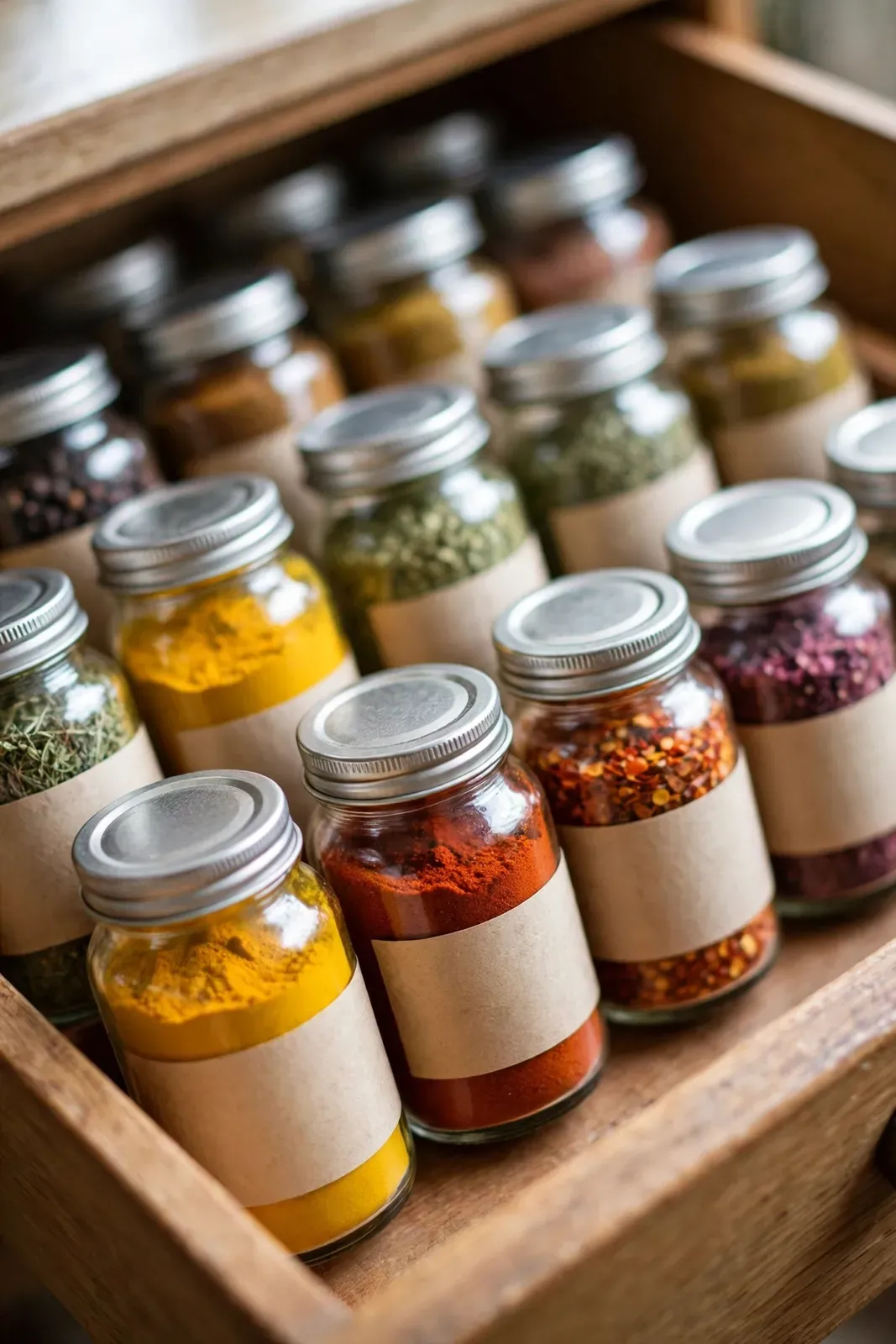
If you cook most nights, you already know the small daily annoyance of hunting for cumin while onions are already browning in the pan. That is exactly the problem spice drawer flat organisation solves. Instead of jars standing upright in a dark cupboard, hidden behind each other, every jar lies flat in a shallow drawer. Open it once and you can see the whole collection at a glance, labels facing up, nothing stacked, nothing forgotten at the back.
It sounds simple, and it is. But the difference in daily cooking is real. You stop buying duplicates because you can finally see what you own. You reach for smoked paprika instead of settling for whatever is at the front. And because the drawer sits close to the stove in most kitchens, seasoning becomes part of cooking rather than a separate treasure hunt through cupboards and carousels. In short, spice drawer flat organisation turns seasoning into the easiest part of cooking.

Why Spice Drawer Flat Organisation Works So Well
A cupboard forces you to read jars from the side, in shadow, often on tiptoe. A flat drawer changes the angle completely. Looking straight down, you read labels the way you read a page. Colour helps too: turmeric glows yellow, chillies are unmistakably red, dried herbs are green. When jars lie flat and evenly spaced, your eye learns the map within a week, and picking the right jar takes seconds. That is the simple heart of spice drawer flat organisation: everything visible, nothing hidden.
There is a second, quieter benefit: freshness. Ground spices lose strength when they sit in light and heat, and a closed drawer protects them from both far better than a countertop rack. To understand what you are storing, it helps to remember that spices are seeds, fruits, roots, barks and other plant parts used mainly for flavour and colour, and most keep best whole, cool and away from steam. A drawer away from the direct heat of the hob, but within arm’s reach, is a sensible home for them.
Measure First: Drawer Depth, Width and Jar Height for Spice Drawer Flat Organisation
Before you buy a single jar, take three measurements and write them down: the inside width of the drawer, its front-to-back depth, and, most important, its clear height from the drawer base to the underside of the worktop. Most successful setups use a drawer between 8 and 12 centimetres high inside. That is enough for a standard small spice jar lying on its side, with a little room for fingers to lift it out. Good spice drawer flat organisation starts with honest measuring.
Next, count honestly. Lay every spice you own on the worktop, group duplicates together, and throw away anything that smells faint and dusty when you sniff it. Ground spices that have lost their scent will not come back. Most home cooks end up with 18 to 30 spices they actually use. That number, plus a little growing room, tells you how many jars and how much insert space you need. If one drawer is not enough, put everyday spices in the top drawer and baking spices or bulk refills in a second drawer below.
Step-by-Step: Setting Up Spice Drawer Flat Organisation
You can finish this project in one afternoon. Work in this order and you will not have to redo anything halfway through. This sequence is spice drawer flat organisation in its simplest, most reliable form.
- Empty and clean the drawer. Take everything out, vacuum up loose seeds and crumbs, and wipe the base with a damp cloth. Let it dry fully so labels do not stick to damp wood.
- Line the base. Add a thin non-slip liner or a flat tray. This stops jars rolling every time the drawer closes and makes spills easy to lift out and wash.
- Test one jar. Lay a single empty jar flat and close the drawer slowly. If it clears the frame with a finger’s width to spare, your jar choice works. If not, switch to shorter or square jars before decanting anything.
- Choose one jar size. Decant into matching jars, roughly 100 to 120 millilitres each. Uniform jars line up neatly, waste no gaps, and look calm every time you open the drawer.
- Fill, but do not overfill. Leave a little air space at the top of each jar so powder does not spill when you open it over the drawer.
- Label the side you actually see. When a jar lies flat, the label should sit on the long side facing up, or on the lid if your jars lie at a slight angle. Use clear, plain words and add the month and year you filled it underneath in smaller writing.
- Arrange by how you cook. Put daily spices nearest the front: salt, pepper, chilli, turmeric, cumin and your usual blends. Group baking spices together, and keep whole spices such as bay leaves and cinnamon sticks in one short row of their own.
- Live with it for a week, then adjust. Move the three jars you reach for most to the very front. A system that matches your habits will stay tidy; one that fights them will not.

Choosing Jars, Labels and Inserts That Last for Spice Drawer Flat Organisation
Glass is the safest default. It does not hold smells, it washes clean, and you can see at a glance whether a jar is nearly empty. Square glass jars use drawer space most efficiently because they sit side by side without gaps, while round jars are cheaper and easier to find. Either works, as long as all the jars match. Mixing five different bottle shapes is what makes a drawer look messy, even when it is technically organised. Matching jars are what make spice drawer flat organisation look calm instead of cluttered.
For inserts, you have three honest options. A ready-made tiered or flat tray keeps rows separated and lifts out for cleaning. Bamboo dividers give the same structure with a warmer look and suit a wooden kitchen well. And the simplest option, a non-slip liner with no insert at all, works perfectly well if your jars are uniform and the drawer is not too deep. Do not buy an insert before you know your final jar size; inserts are cut for specific jar widths, and a mismatch leaves awkward half-spaces.
For labels, paper looks lovely on day one but stains quickly where turmeric is involved. Wipe-clean labels, or a fine paint pen on the lid, survive far longer. Keep the writing large enough to read from standing height.
Spice Drawer Flat Organisation on a Budget: Honest Buying Advice
This project does not need to cost much, and spending more does not always make it work better. Start with what you already own. Many people find they already have enough matching jars once duplicates and old gift sets are gathered together. If you do buy jars, buy them in a single multipack rather than one by one; multipacks are cheaper per jar and guarantee the sizes truly match. Kept simple, spice drawer flat organisation stays affordable as well as tidy.
Spend your money in this order. First, decent jars with lids that seal well, because a loose lid means stale spices and spills. Second, labels you can read and wipe clean. Third, only if rows keep sliding around, an insert or liner. Skip expensive motorised racks, oversized designer sets with spices pre-filled at a markup, and any system sized for a drawer you do not have. Pre-filled sets in particular often include blends you will never open, which is wasted money and wasted drawer space.
A realistic budget is modest: jars, labels and a liner often cost less than a family takeaway. If money is tight, do half the drawer now and finish it next month.

Common Mistakes to Avoid With Spice Drawer Flat Organisation
The most common mistake is choosing jars that are slightly too tall. The drawer seems to close, but jars scrape, labels tear, and eventually the drawer gets forced and sticks. Always test one jar first, as described above. The second mistake is placing the drawer directly above or beside the hottest part of the oven and leaving jars there for years. A little distance from constant heat protects flavour.
History offers a useful reminder here. The long and costly spice trade that once made pepper and nutmeg worth long sea voyages shows how prized these ingredients were; it seems a shame to let them fade in a steamy cupboard after all that effort. Keep them cool, dry and sealed.
Other mistakes are smaller but add up: labelling only the lid when the lids get swapped during refills, arranging alphabetically when you actually cook by cuisine, filling jars to the brim so powder puffs out on opening, and forgetting whole spices entirely so bay leaves end up crushed under jars. Finally, avoid the temptation to decant bulk bags straight into jars without a funnel. Five patient minutes with a funnel saves twenty minutes of cleaning turmeric off everything you own. Avoid these small errors and spice drawer flat organisation will keep working for years.
Frequently Asked Questions About Spice Drawer Flat Organisation
How deep does a drawer need to be for flat spice storage?
An inside height of about 8 to 12 centimetres suits most standard spice jars lying flat. Shallower drawers can work with small square jars. Always test one jar and close the drawer slowly before decanting your whole collection.
Will spices stay fresh lying flat in a drawer?
Yes, often fresher than on a countertop rack, because the drawer blocks light and stays relatively cool. Keep lids sealed tightly and avoid the drawer closest to oven heat if you have a choice. Whole spices keep longest, while ground spices are best used within about six to twelve months.
How many jars fit in a typical kitchen drawer?
A medium drawer around 60 centimetres wide usually holds 20 to 30 uniform jars lying flat in rows, depending on jar size and whether you use an insert. Measure your drawer and your chosen jar together rather than relying on product photos, which are often shot in oversized drawers.
Should I arrange spices alphabetically or by use?
By use works better for most home cooks, because you grab flavours in groups while cooking. Put everyday spices at the front and group baking and whole spices together. Alphabetical order suits very large collections, but only if everyone in the house sticks to it.
What if my kitchen has no spare drawer?
Use the same flat principle elsewhere: a shallow tray in a cupboard, a low box on a pull-out shelf, or jars lying flat in a deep basket all give you the same see-everything benefit. Good kitchen planning has always been about storing, preparing and cooking with fewer wasted steps, and a flat tray follows exactly that idea, drawer or no drawer. The principle behind spice drawer flat organisation works in any kitchen.

Once your drawer is set up, cooking feels calmer in a way that is hard to explain until you live with it. You open one drawer, see everything, season with confidence, and close it again. No rummaging, no duplicates, no mystery jar from three years ago. Give the system a week, move your most-used jars to the front, and it will quietly become one of the hardest-working corners of your kitchen. That is the quiet reward of good spice drawer flat organisation.