A staircase is the one wall in the house that everybody walks past several times a day, yet in most homes it stays bare from skirting board to landing. A well-planned staircase wall gallery turns that daily climb into a slow reveal of photographs, prints and small artworks, arranged so the whole collection rises with the steps instead of fighting them. Done badly, the same wall looks like frames were thrown at it from the bottom step. The difference is almost never the art itself. It is the layout line the frames follow, the spacing between them, and whether the collection was planned on paper before a single nail went in.
This guide walks through the rules that make a staircase wall gallery feel intentional: how to find the diagonal line your frames should follow, how to mix sizes without chaos, the paper-template method that removes the guesswork, and the budget route to filling a long wall without buying everything at once. The staircase itself has a long design history, from grand ceremonial flights to the compact stairs in most modern homes, and you can read more about how staircases are built and proportioned if you enjoy the background.
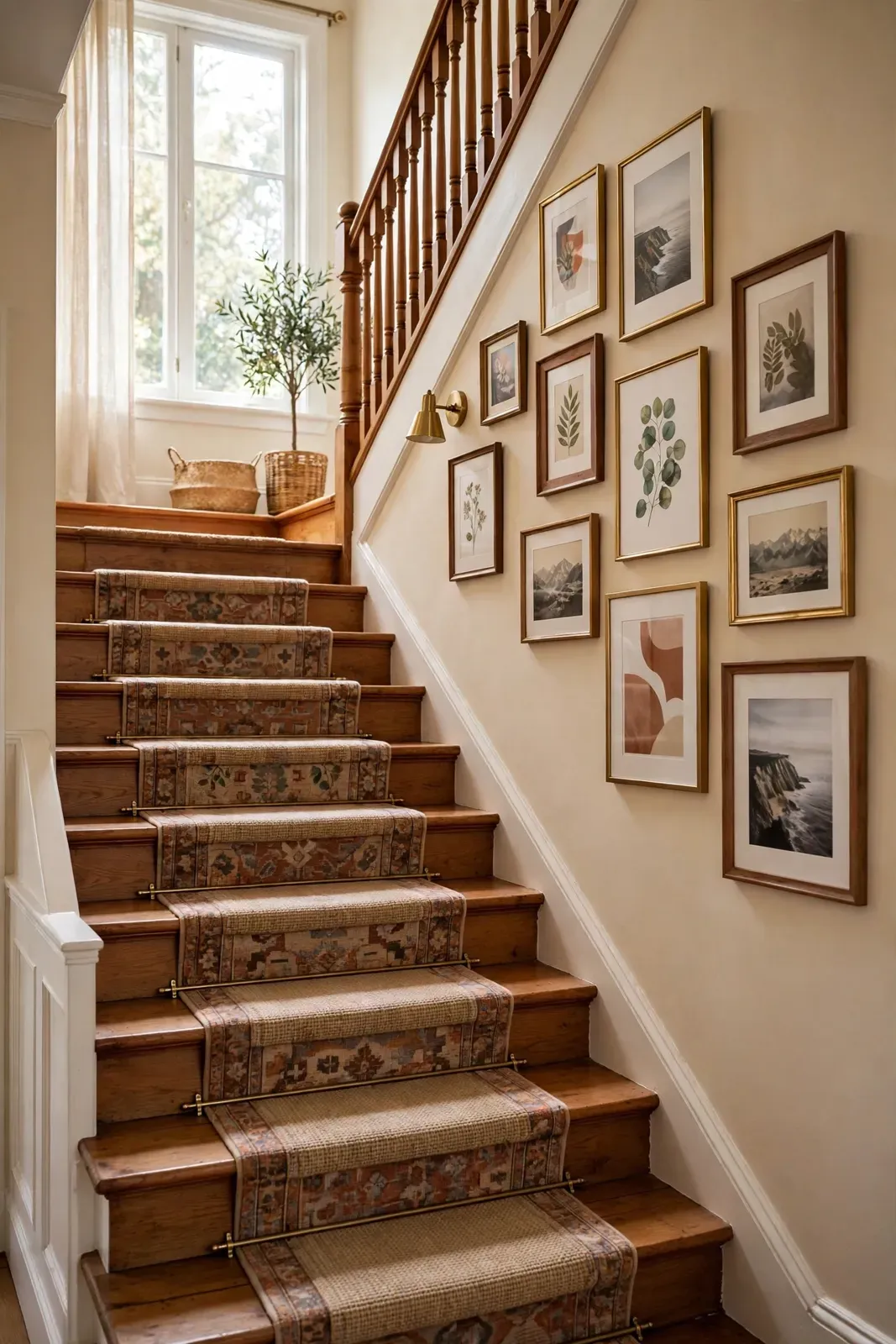
Table of Contents
Start With the Diagonal: The Line Every Staircase Wall Gallery Follows
Stand at the bottom of your stairs and look up. The handrail draws a clean diagonal, and your gallery should echo it. The most reliable approach is to imagine a second line running parallel to the handrail, roughly 150 to 160 centimetres above each step’s front edge, as if an invisible person of average height were walking up with their eye level marked on the wall. The centres of your frames should hover around that line, some a little above, some a little below, but never drifting so far that the group stops reading as one rising band.
A common alternative is the stepped layout, where frames sit in small horizontal clusters, each cluster one step higher than the last, like a staircase drawn inside the staircase. This suits very tidy, symmetrical collections of same-size frames. The diagonal flow suits mixed collections better, because the eye travels smoothly instead of hopping. Whichever you choose, commit to one system for the whole flight. Mixing a diagonal at the bottom with random clusters at the top is what makes most DIY attempts look accidental.
Choosing Frames and Art for a Staircase Wall Gallery Climb
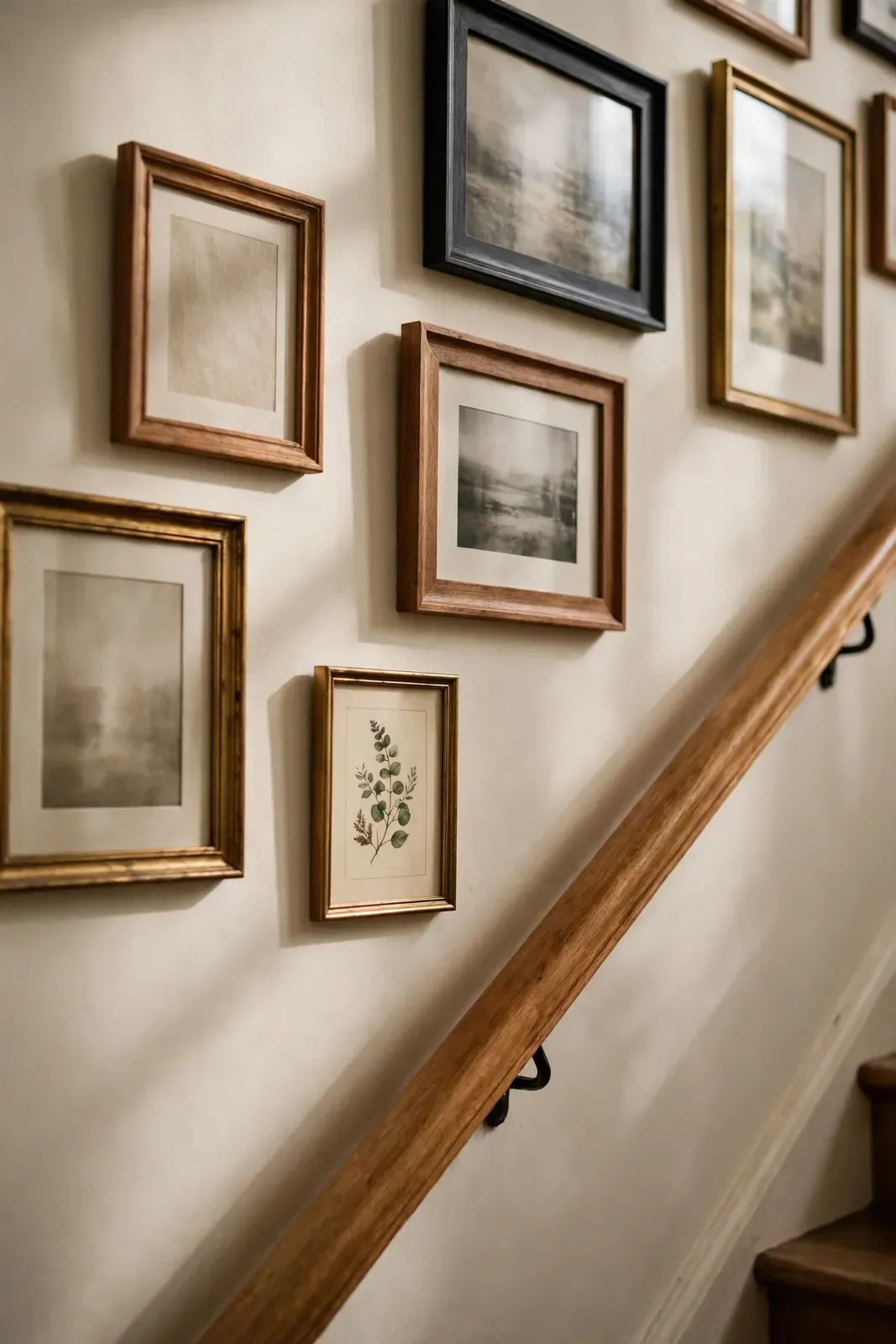
Variety works in a staircase wall gallery, but it needs one unifying thread. Pick two, at most three, frame finishes and repeat them along the whole climb: warm walnut and brushed brass, or black and natural oak. Within that frame family, vary the sizes freely, from small 13 x 18 cm prints up to one or two anchor pieces around 50 x 70 cm. The anchors matter. Place the largest piece near the middle of the flight, where the wall is most visible from the hall, and let smaller frames gather around it.
For the art itself, a stair gallery rewards a loose theme rather than identical sets. Botanical prints mixed with landscape photographs, family pictures beside one abstract piece, travel posters with a couple of line drawings: the mix feels collected over time. A decent picture frame with a proper mount (the card border inside the frame) makes even a printed-at-home image look deliberate, so spend on mounts before you spend on art. If you already have a flat wall collection elsewhere in the house, our guide to gallery wall arrangement ideas covers grid and salon layouts that pair well with this approach.
The Paper Template Method, Step by Step
This is the step that separates a calm Saturday project from a wall full of regret holes. Follow it in order:
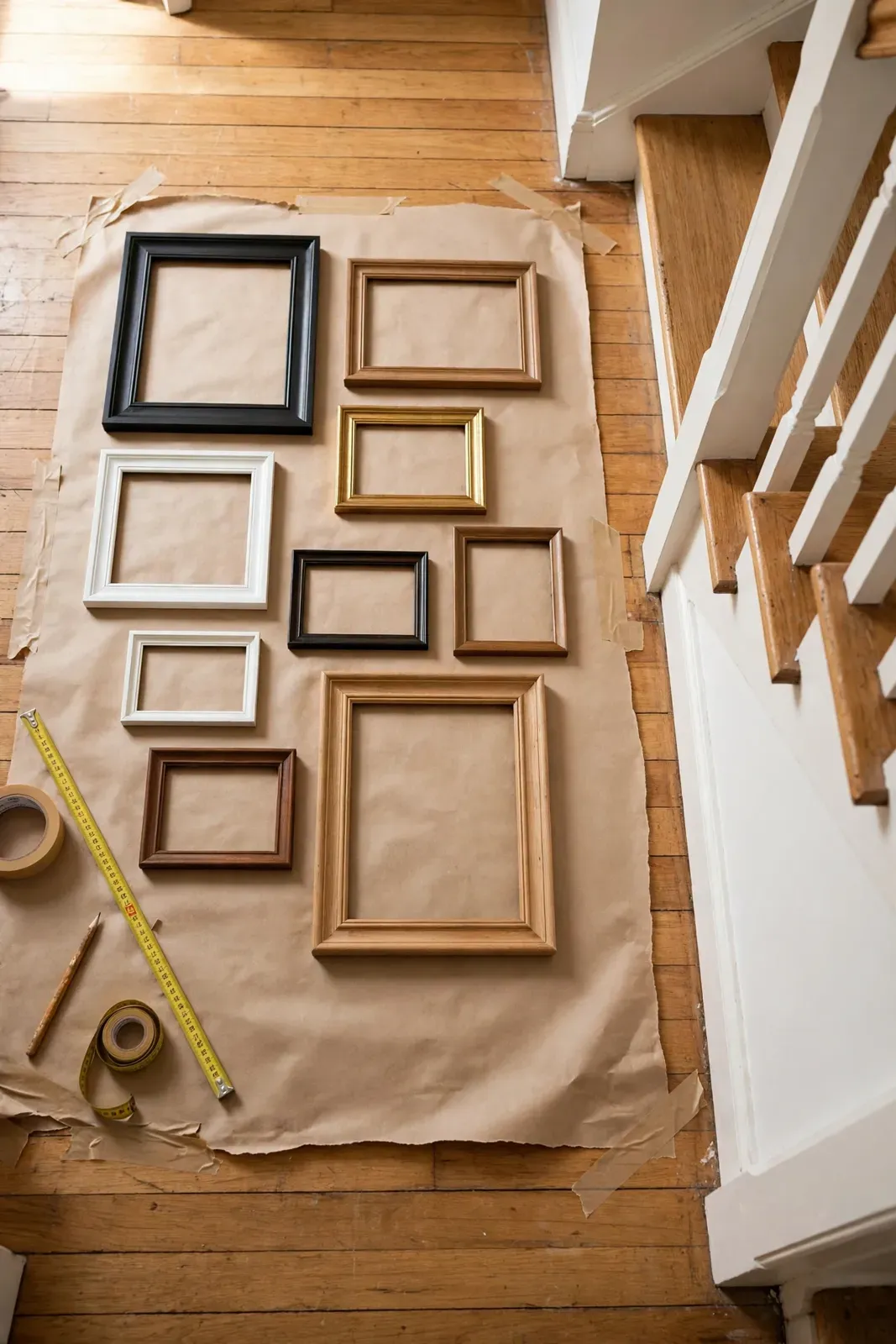
- Trace every frame. Lay each frame on kraft paper or old wrapping paper, draw around it, cut the shape out and write the frame’s position number on the paper.
- Mark the diagonal. With painter’s tape and a long straight edge, run a light tape line up the wall parallel to the handrail at eye level above the steps.
- Tape the paper shapes up. Arrange the paper frames along the tape line, keeping gaps between shapes at a consistent 5 to 8 centimetres. Live with it for a day; walk up and down past it at normal speed.
- Adjust from the hall. The view from the bottom step and from the landing matters more than the view standing on the stairs themselves. Shift pieces until both views feel balanced.
- Mark and hang. Push a pin through each paper shape at its hanging point, remove the paper, and fix your hooks on the pin marks. Hang the real frames in number order.
Spacing, Height and Lighting Rules That Keep a Staircase Wall Gallery Tidy
Consistent gaps are the quiet secret of a staircase wall gallery. Whether frames are large or small, keep the space between neighbours within a narrow band, around 5 to 8 centimetres, measured frame edge to frame edge. The moment one gap doubles, the eye reads it as a mistake rather than a pause. Keep the lowest frame’s bottom edge at least 20 centimetres above the step directly beneath it, so nothing gets knocked by passing shoulders, bags or the vacuum cleaner.
Light decides whether your staircase wall gallery glows or glares. Glass reflects, so if a window faces the stair wall, choose anti-reflective acrylic or matt prints for the pieces opposite it. A small picture light or a warm wall sconce halfway up the flight turns the gallery into an evening feature, and it makes the climb feel shorter, which anyone carrying laundry upstairs will appreciate.
Budget and Buying Advice for a Long Staircase Wall Gallery
A staircase wall gallery can swallow twelve to twenty frames, so buy in stages. Start with the anchor pieces and frames from mid-range home stores, where a mounted 50 x 70 cm frame typically costs what a coffee-shop lunch for two does. Fill the smaller sizes from charity shops and market stalls; mismatched old frames look completely unified after one coat of the same paint colour. Print art at home or through an online print service using free public-domain collections from museum websites, which offer high-resolution artwork downloads at no cost.
One warning on cheap frames for a staircase wall gallery: very light plastic frames twist on their hooks and never hang straight on a diagonal. On stairs, where you see frames at an angle, a crooked frame is twice as visible. Buy frames with a bit of weight, or add small adhesive pads at the bottom corners to hold them level against the wall.
Mistakes That Make a Stair Gallery Look Messy
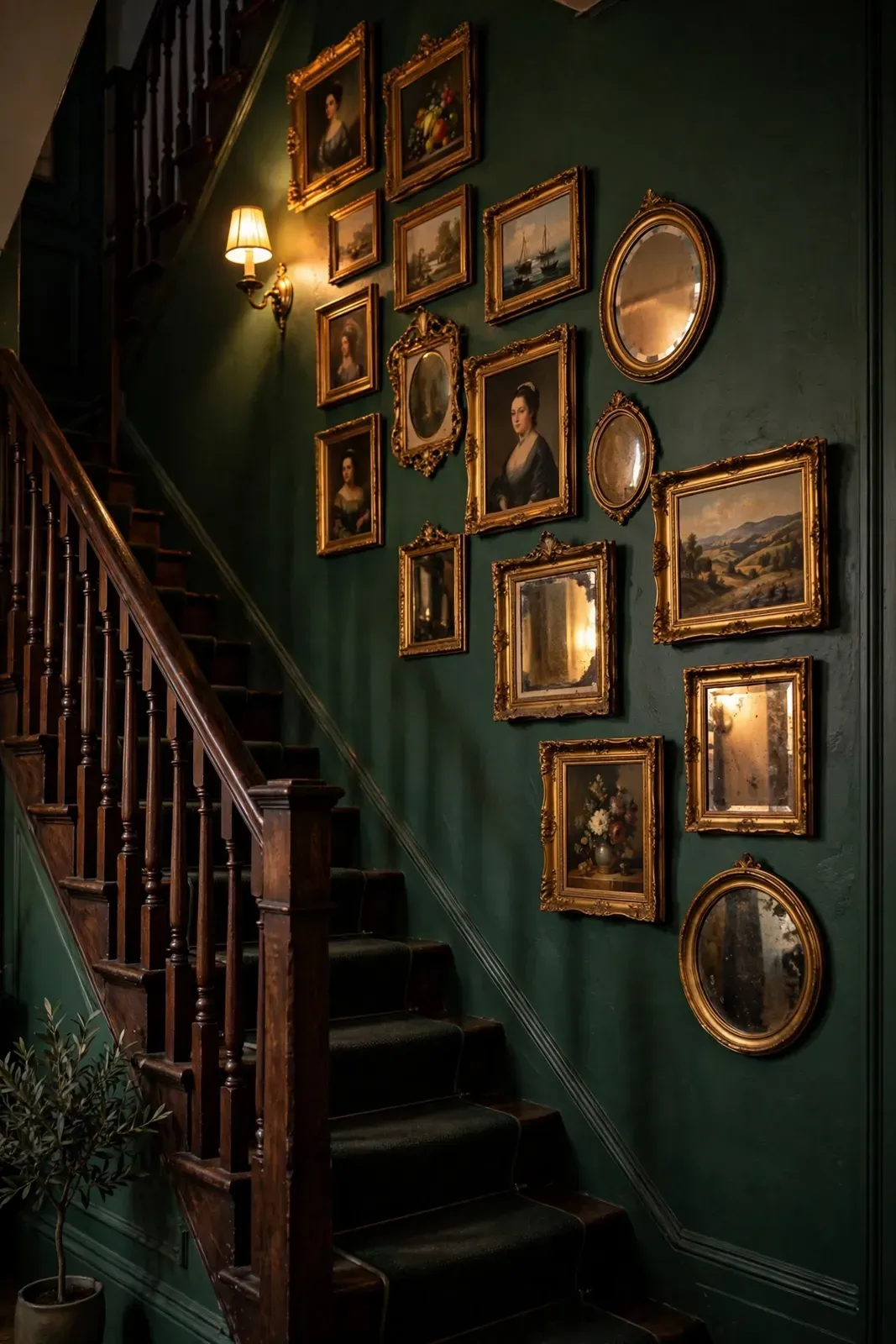
The first mistake in a staircase wall gallery is hanging frames too high, following the ceiling line instead of the steps, so the collection floats away from anyone climbing. The second is using only tiny frames: a long wall needs size contrast, or the whole thing reads as visual noise. The third is centring every frame on the diagonal with ruler precision; a gallery should breathe a little above and below the line, or it looks like a shop display. Finally, avoid drilling the final holes on your first arrangement. The template stage feels slow, but it is the whole reason the finished wall looks calm.
Frequently Asked Questions
How many frames do I need for an average staircase?
For a standard straight flight of twelve to fourteen steps, nine to fifteen frames usually fill a staircase wall gallery comfortably, depending on their sizes. Start with eleven pieces, including one or two large anchors, and add more only if the template stage shows obvious empty stretches at the top or bottom.
Should all the frames match exactly?
No. Matching every frame makes the wall feel like a hotel corridor. Limit yourself to two or three finishes and repeat each finish at least three times along the flight. That repetition is what ties different sizes and subjects together into one collection.
Can I hang a staircase gallery in a rented home?
Yes, with adhesive picture strips rated for the frame’s weight, or by hanging lighter frames from a picture rail if your home has one. Keep frames under about two kilograms each on strips, and use two strips per frame on a diagonal wall, because the angle puts uneven pull on the fixing.
What should I do about the turn on an L-shaped staircase?
Treat the landing as a pause in the story. Place one larger piece on the landing wall itself, hung at normal standing eye level, then restart the diagonal on the second flight. Trying to wrap small frames around the corner usually looks fussy and crowded.
How do I stop frames from tilting on the stairs?
Use two fixings for wide frames in a staircase wall gallery, keep frames resting on a small adhesive pad at each bottom corner, and choose hooks rather than a single nail where possible. A frame that hangs from two points at the same height will stay level even when doors slam and feet thud past it daily.
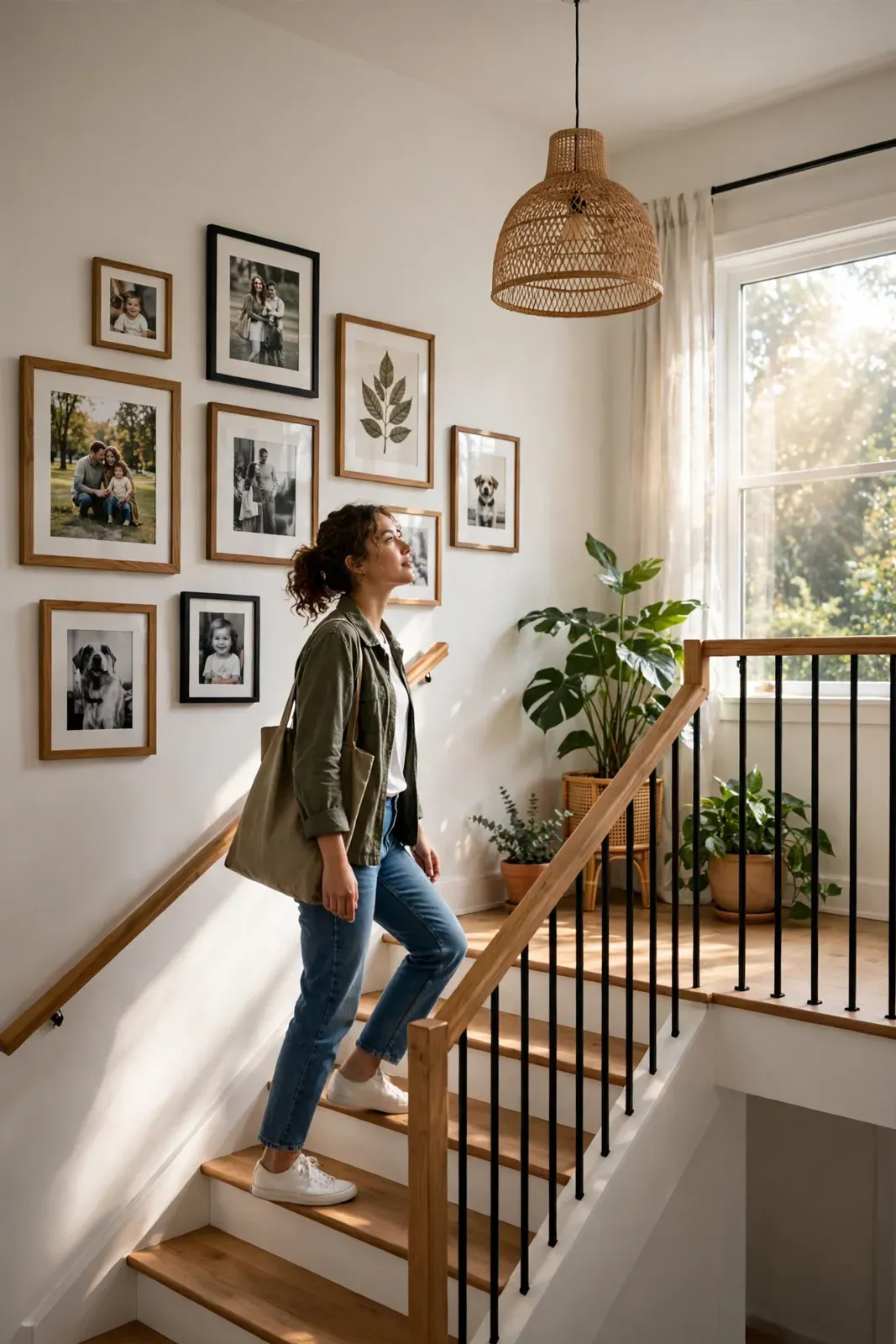
A staircase wall gallery is one of the few decorating projects that improves a room you do not even sit in. Plan the diagonal, trust the paper template, keep your gaps honest, and the climb upstairs becomes the most interesting walk in the house.