Table of Contents
Every home has that moment: the bathroom mirror is cloudy, the kitchen tap has water spots, and you spend ten minutes hunting for the right spray, a clean cloth, and the small brush that has migrated to the back of a cupboard. A well-planned utility closet cleaning caddy ends that hunt. Instead of loose bottles rolling around on a shelf, everything you need for a quick clean lives in one sturdy, handled carrier, ready in the closet. You grab it, walk to the room that needs attention, do the job, and put the whole thing back in one trip.
Most cleaning frustration is not about scrubbing at all. It is about friction — the missing cloth, the duplicate bottle bought because the first was buried behind the mop bucket. A utility closet cleaning caddy removes that friction. This guide covers what to put in it, how to arrange the closet around it, how to set it up step by step, and how to keep it tidy without spending much.

Why a Utility Closet Cleaning Caddy Changes the Whole Routine
Think of the utility closet as a small storeroom and the utility closet cleaning caddy as your travelling kit. The closet holds spares, bulk refills, the broom and mop, and things you need only occasionally, like a plunger. The caddy holds only the everyday workers: the sprays, cloths, brushes and gloves you reach for several times a week. That split is the heart of the system. When the two jobs are mixed, the closet becomes a jumble and every clean starts with digging.
With a utility closet cleaning caddy, a fifteen-minute bathroom tidy really takes fifteen minutes. Mirror, basin, tap, toilet seat and floor spots can all be handled with what is already in your hand. In the kitchen, the same carrier covers the hob, sink, worktops and fridge front.
There is a safety benefit too. Cleaning products are household chemicals that deserve careful storage and handling, especially with children or pets at home. Keeping the everyday set upright, together, and returned to one closet shelf after each use is far safer than scattering bottles under every sink.
What Belongs in Your Utility Closet Cleaning Caddy
Start with surfaces, not brands. Most homes need something for glass, something for general surfaces, something for kitchen grease, and something suitable for the bathroom. Four bottles is plenty. If a fifth product only works on one rarely cleaned item, keep it on the closet shelf and fetch it when needed. A stuffed caddy is heavy, awkward on stairs, and no quicker than the cupboard it replaced.
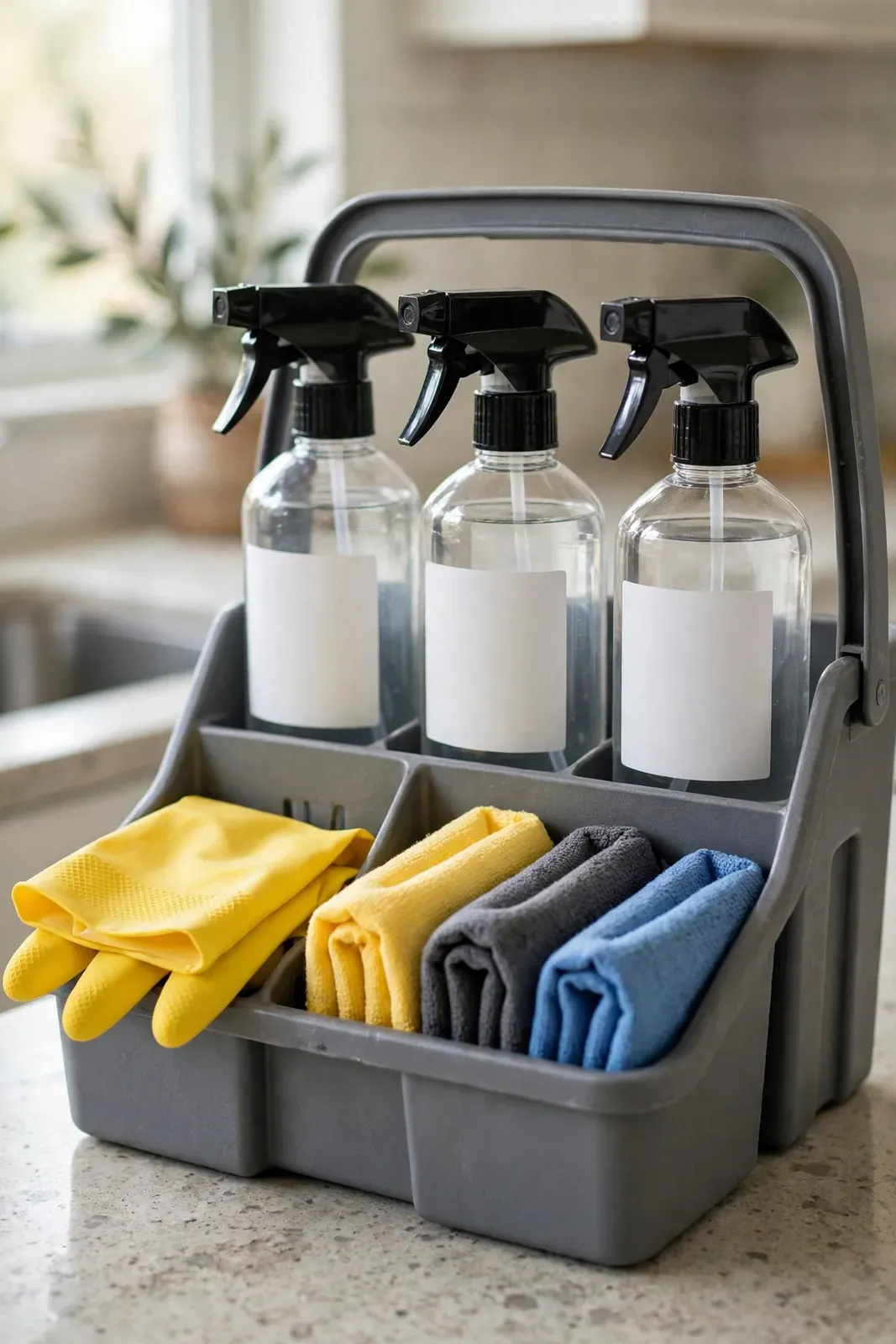
Alongside the bottles, pack the tools that do the real work. Two or three folded microfibre cloths handle most jobs; keep one colour for the bathroom and another for the kitchen if that helps everyone remember. Add a small scrub brush for taps and grout, a non-scratch sponge, reusable rubber gloves, and a folded bag or roll of small bin liners for bits you pick up along the way.
Leave breathing room. Aim for a utility closet cleaning caddy that feels about three-quarters full. Bottles should stand upright without being wedged, cloths should lift out cleanly, and you should see at a glance what is missing. That glance is your restock reminder.
How to Set Up Your Utility Closet Cleaning Caddy, Step by Step
Step 1: Empty the closet completely. Take everything out shelf by shelf, wipe the shelves, check corners for old spills, and let the space dry. Sorting from an empty closet is honest work; sorting around piles just moves the mess.
Step 2: Group what you found. Make simple piles: everyday cleaning, occasional jobs, laundry items if they live here, and anything that does not belong in this closet at all. Be firm with that last pile — paint tins and mystery chargers are usually what squeeze the cleaning kit into chaos.
Step 3: Check dates, labels and condition. Set aside empty bottles, products you never use, and anything with a damaged or unreadable label. Never mix leftover products together, and never pour a product into an unlabelled bottle. If you cannot identify something, dispose of it through your local household waste service rather than guessing.
Step 4: Load the caddy in working order. Tall bottles go in the middle or back, cloths folded in a side pocket, brush and sponge where they can dry, gloves on top. Carry it once around the house. If it bangs your leg or strains your wrist, rearrange it now.
Step 5: Give everything else a fixed home. Refills go behind or above the caddy spot, brooms and mops stand on one side, and occasional items take the highest or lowest shelf. The caddy gets the easiest shelf to reach, roughly waist to shoulder height.
Step 6: Do a one-week trial. Note anything you had to fetch separately twice — that item has earned a place in the caddy. Anything you never touched can move back to the shelf. A short trial tunes the kit to your real habits.

Organising the Closet Around the Utility Closet Cleaning Caddy
The closet works best in loose zones. The middle zone is the daily zone: the caddy, a small basket of clean cloths, and bin liners. The upper zone suits refills, stored upright in a tray or low-sided box so a slow leak cannot spread. The floor zone is for tall or heavy things — mop bucket or vacuum — with brooms clipped along one wall so they do not fall across the doorway.
If your closet is shallow, the back of the door is valuable space. An over-door organiser with clear pockets can hold brushes, dusters and spare sponges. Keep it light; a door sagging under heavy bottles is a repair you do not need. In a small apartment with no true utility closet, the same idea shrinks into one cupboard: caddy on one side, folded towels on the other.
Labels help, but they need not be fancy. Masking tape and a marker on a basket edge will do. The point is that anyone in the house can return an item without asking, which keeps the system alive. It is also a good job to fold into a seasonal reset — the tradition of spring cleaning as a thorough, whole-house refresh is centuries old, and a working closet makes that bigger clean far less daunting.

Budget and Buying Advice for Your Utility Closet Cleaning Caddy
You may not need to buy much. If you already own a sturdy bucket or a plastic tote with a handle, try that as your carrier for a fortnight first. When you do buy a caddy, spend on the handle and the base. A handle that digs into your fingers will annoy you on every trip, and a thin base that bows under bottles will eventually crack. Hard plastic that rinses clean is the practical choice; fabric carriers hold damp smells and stains.
Size matters more than compartments. Measure your shelf and your largest bottle before ordering. Most homes do well with a medium caddy around 30 to 40 centimetres long.
For contents, buy refills where they suit you, and always refill the original labelled container. A sensible starter set — one caddy, four cloths, a brush, a sponge pack and gloves — costs roughly a single takeaway meal in most markets and serves for years. Skip bundle kits packed with tools you did not choose; they usually contain two useful items and six that become clutter.
Utility Closet Cleaning Caddy Mistakes to Avoid
The most common mistake is overfilling. A caddy carrying nine bottles feels thorough on day one and stays in the closet by week three because lifting it is a chore. Keep it light enough to carry in one hand while opening doors with the other. The second mistake is parking it on the floor in front of shelves, where it collects dust and drips. It deserves a shelf or a clear spot at the side.
Mixing chemicals is the mistake with real consequences. Never combine bleach with acidic or ammonia-based cleaners, never layer two strong products on one surface without rinsing, and always read the label before first use. Damp storage is another quiet problem: cloths put away wet will smell within days. Rinse them, wring them well, and let them dry before the closet door closes.
Finally, avoid the duplicate trap. One open bottle of each type, in the caddy, is the rule. Backups live together on the refill shelf, so you can see your stock at a glance.

Keeping Your Utility Closet Cleaning Caddy Tidy Week After Week
Systems survive on tiny habits, not big reorganisations. When you finish a clean, wipe the caddy, check caps are closed, and put damp cloths in the wash basket rather than back in the carrier. Once a month, take sixty seconds to check levels and add anything low to your shopping list. Twice a year, repeat the full shelf wipe. That is all the maintenance this system needs, and if everyone at home can find, use and return the caddy without instructions, the closet will stay tidy on its own.
Utility Closet Cleaning Caddy: Frequently Asked Questions
How big should a Utility Closet Cleaning Caddy be for an average home?
A medium caddy holding four bottles, a few cloths, a brush, a sponge and gloves suits most homes. It should fit your shelf and feel comfortable carried in one hand when loaded.
Can I use one Utility Closet Cleaning Caddy for the whole house, or do I need one per floor?
One caddy is enough for most single-floor homes and small apartments. In a larger house, a second small bathroom caddy upstairs can save many trips.
How do I stop the Utility Closet Cleaning Caddy smelling damp?
Rinse and wring cloths and sponges after use and let them dry fully before closing the closet door. Wipe the caddy weekly, since drips collect in the base, and replace sponges regularly rather than keeping them for months.
What should I do with old or unlabelled cleaning products?
Do not use, mix or decant anything you cannot identify. Keep it upright, away from children and pets, and dispose of it through your local household hazardous waste service, following any guidance on packaging you can still read.
Is a Utility Closet Cleaning Caddy suitable for a very small apartment?
Yes, it suits small homes especially well because it takes one shelf or half a cupboard. Choose a compact caddy, hang tall tools behind a door, and keep only weekly essentials in it; occasional items can share one lidded box.
A tidy closet will not clean your home for you, but it removes every small delay standing between you and a quick clean. Set up your caddy this week, adjust it once, and enjoy finding everything exactly where it should be. Grab, clean, return — it really can be that simple.